Online Inkjet Printer: CE-Covered Models, Line Specs and Integration Checks
An online inkjet printer is a coding unit mounted over or beside a conveyor that prints automatically when a sensor detects a passing product. Buyers do not choose it by preference; they specify it against constraints — line speed, print window, substrate, ink chemistry, trigger interface and the compliance file the destination market requires. This guide works through those constraints using DEMIN's S10 and L10 online platforms, and separates what is documented in writing from what still has to be proven on your own line.
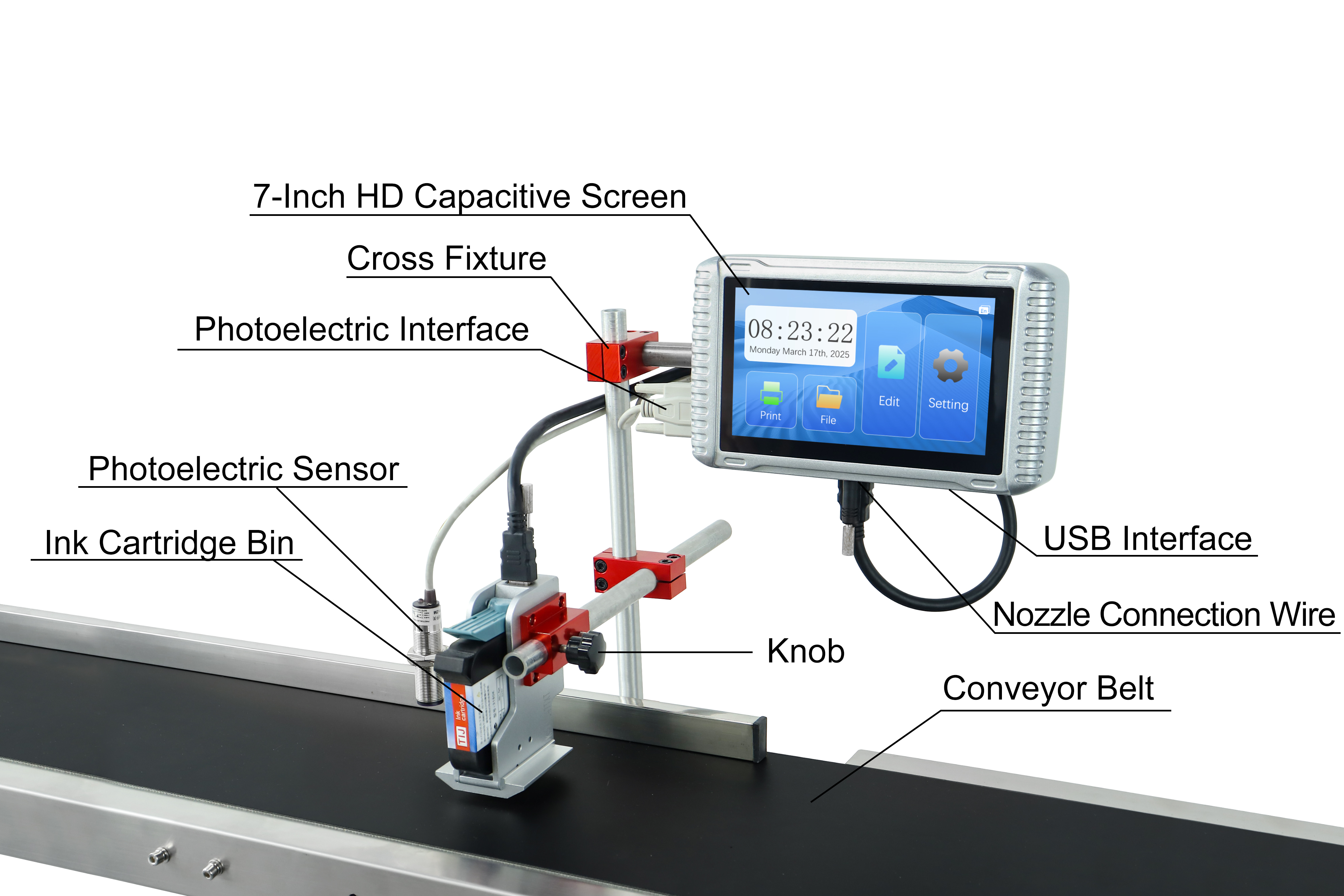
Cover image: DEMIN L10 online inkjet printer, a modular in-line coding unit with a 7-inch capacitive touch screen.
What “online” changes about the specification problem
An online (in-line) inkjet printer is specified against four hard constraints that a handheld device is not: continuous line speed, a fixed print window above a moving product, a trigger interface, and a substrate–ink pairing that has to survive whatever happens downstream. A handheld printer can be re-aimed by an operator between jobs; an online unit cannot. That is why most failing online coding projects fail at specification rather than at the printhead.
The four failure modes appear in a predictable order:
- Speed mismatch. A print speed lower than the conveyor speed produces stretched or skipped codes. The DEMIN S10 and L10 online models are rated at 120 m/min; the M10 and H50 handheld models are rated at 60 m/min. If your line runs above the rating, the printer is the wrong class of machine, not a machine that needs tuning.
- Window and distance mismatch. The online models have a print height of 2–12.7 mm and an optimal printing distance of 2–5 mm. A 2–5 mm working distance is tight: bracket rigidity and product thickness variation both matter. The P70 and P70 Pro UV platforms widen this to a 5–72 mm print height at a 2–15 mm distance, which is why they are used where the product profile changes.
- Ink and substrate mismatch. Ink adhesion depends on the surface, not on the printer. Uncoated kraft paper, coated carton, shrink film, metal and plastics behave differently, and adhesion has to be tested rather than assumed.
- Documentation gap. A machine that prints perfectly can still be blocked at customs or at a customer audit if the correct conformity file does not exist for the exact model and market.
Treat the first three as engineering questions and the fourth as a procurement question. They are decided by different people inside the buyer's organisation and usually at different times, which is why they are so often decided badly.
Industry background: why documentation now sits beside speed
Industrial inkjet is a segment inside a much larger inkjet market, and the two figures are frequently quoted as if they were the same number. Global Market Insights valued the industrial inkjet printer segment at USD 5.6 billion in 2025, with the Food & Beverage vertical accounting for 26% of that segment's revenue. Grand View Research sizes the total inkjet printer market — consumer and desktop units included — under a different scope, so the two estimates cannot be averaged or substituted for one another.
Within industrial marking, technology choice is not evenly split. Continuous Inkjet (CIJ) held a 38.4% revenue share by technology in 2025, according to Grand View Research, while thermal inkjet (TIJ) platforms such as the S10 and L10 compete on simpler maintenance and cartridge-based consumables. On geography, Smithers expects Asia Pacific to draw level with North America in inkjet volume by 2026 and to lead by 2031.
What has changed for buyers is not the technology but the evidence threshold. Conformity documentation, model-level specification sheets and traceability of the exact configuration are now requested at the evaluation stage rather than after the purchase order. A supplier that can produce a certificate number with matching model coverage shortens the review; a supplier that can only produce a logo extends it.
The DEMIN online platform: what the S10 and L10 actually specify
Quanzhou Demin Spraying Code Technology Co., Ltd. (DEMIN) is a Chinese inkjet printer manufacturer founded in 2017, operating a 3,000 m² factory with 150 employees, a 45-person R&D team and a reported annual output of 10,000 units, roughly 50% of which is exported to markets including Europe, the Americas, the Middle East and Asia. Its published portfolio spans handheld, desktop, online and UV inkjet platforms, together with laser coding equipment.
The two inline models in that portfolio — DEMIN S10 and DEMIN L10 — share the same core specification envelope, which makes model selection a question of configuration and documentation rather than of headline performance:
- Print speed: 120 m/min, suitable for continuous conveyor operation rather than stop-start indexing.
- Print resolution: 300–600 dpi, adjustable; the higher setting is what makes small QR and barcode elements reliably scannable.
- Print height: 2–12.7 mm, i.e. a single line or a compact multi-line block, not a large-format panel.
- Optimal printing distance: 2–5 mm from the product surface.
- Body and weight: cast aluminium alloy, 3.5 kg.
- Control: 7-inch capacitive touch screen; the structural configuration is a modular design intended to be compatible with various production line installations.
- Power: DC 16.8 V, 3 A.
- External interfaces: DB9 sensor interface and USB interface.
- Printable content: Chinese and English characters, QR codes, barcodes, serial numbers and logos.
- Ink colours: red, yellow, blue, green, black, white and invisible.
- Interface languages: 29 languages including Chinese, English, Russian, Arabic, French and Vietnamese.
- Software: a self-developed operating system with an ink-volume calculation function, which the manufacturer states reduces ink consumption.
The practical reading of this specification is narrow and useful. The S10 and L10 are built for the mainstream case: a product moving at controlled speed, passing a fixed head at a fixed distance, receiving one to a few lines of variable data — a date, a batch number, a serial number, a QR code. They are not the correct choice for a 60 mm-tall print block, for a product whose surface distance varies by more than a few millimetres, or for a line that must run above 120 m/min.
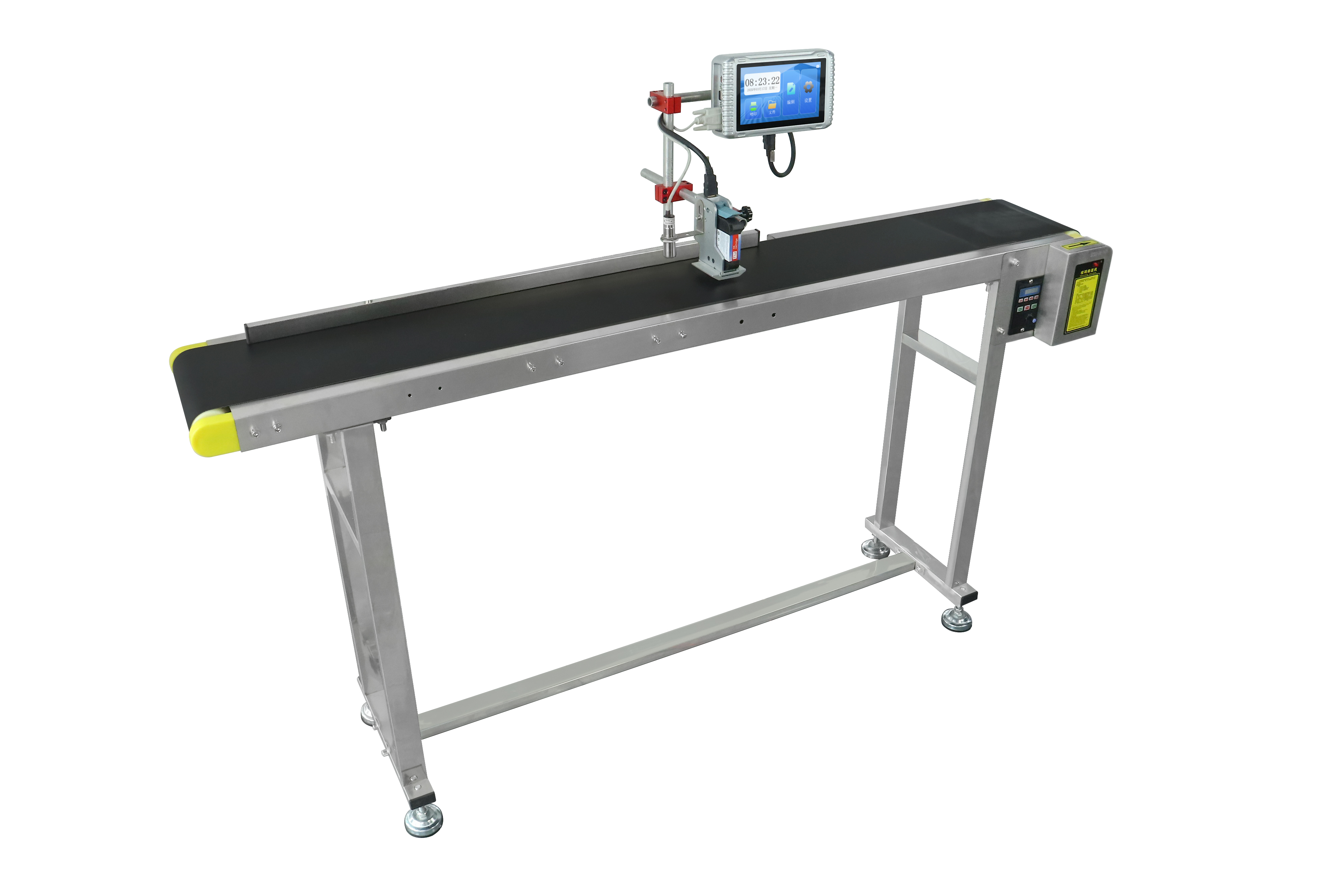
The L10 online inkjet printer uses a cast aluminium alloy body at 3.5 kg, with a 7-inch capacitive touch screen and a modular mounting configuration for different production line installations.
The compliance layer: what the CE and FCC files actually cover
This is the part of an online inkjet printer purchase that is most often misunderstood, because a certificate number is not the same thing as coverage. A conformity document covers named models, a named directive, a named set of standards and a named market. If any of those four do not match your order, the document does not apply to you.
EU market: the S-series CE attestation
The in-line inkjet printers S10, T110, S20, S100 and S200 are covered by CE Attestation of Conformity AOCXMTN3231226-78308E-02, issued on 2024-02-01 by Bay Area Compliance Laboratories Corporation (BACL). The attestation declares conformity with EMC Directive 2014/30/EU and covers EMC Clause 1(a) emission requirements and Clause 1(b) immunity requirements. The applicable standards listed are EN 55032:2015+A1:2020, EN 55035:2017+A11:2020, EN IEC 61000-3-2:2019+A1:2021 and EN 61000-3-3:2013+A2:2021.
The DEMIN L10 online inkjet printer is separately listed among the DEMIN models covered by CE attestations of conformity for the EU market, alongside the H50 handheld, the M10 handheld and the P70 and P70 Pro UV models. Buyers should ask for the document that names L10 explicitly rather than relying on the model being mentioned in a general list.
EU market: the handheld files, for reference
Handheld coverage is documented in two further attestations. Models T1, T2, T3, T10, T20 and T50 are covered by CE Attestation of Conformity AOCXMTN3231012-59588E-02, issued on 2023-10-31 by BALC, naming Quanzhou Demin Spraying Code Technology Co., Ltd. at No. 11, Sunshine Road, Xiamen Town, Nan'an City, Quanzhou City, against the same EMC Directive and the harmonised standards EN 55032:2015+A11:2020+A1:2020, EN 55035:2017+A11:2020, EN IEC 61000-3-2:2019+A1:2021 and EN 61000-3-3:2013+A1:2019+A2:2021. Models MX3S, M10, M20 and D10 are covered by CE certification AOC RXM211108050-02, issued by Bay Area Compliance Laboratories Corp. (Kunshan) under EMC Directive 2014/30/EU.
US market: FCC coverage is handheld-only in the published record
DEMIN's Class B handheld inkjet printers T1, T2, T3, T10, T20 and T30 are covered by a Supplier's Declaration of Conformity for the US market under certification number XMTN3230612-33144E-00, issued on 2023-07-25 by Bay Area Compliance Laboratories Corp. (Dongguan) against Part 15 of the FCC Rules and Regulations for Radio Frequency Devices. The responsible party named is Quanzhou Demin Printing technology co., LTD, and the record lists no expiration date.
A second declaration, number 2404Z55407E-EM, was issued on 2024-12-03 by Shenzhen Accurate Technology Co., Ltd. and covers handheld models D10, M10, MX3, M20 and M100 against FCC Part 15 Subpart B Class B.
What this means for a US-bound online line: the FCC declarations visible in DEMIN's compliance record cover handheld platforms. No FCC declaration for the S10 or L10 online models appears in the same record set. A buyer shipping an S10 or L10 into the United States should request the model-specific FCC declaration before design freeze, and should not assume that a handheld declaration extends to an in-line machine.
Management system and company-level qualification
Beyond product conformity, DEMIN holds ISO 9001 Quality Management System certification, National High-Tech Enterprise status, and independent patents and software copyrights covering self-developed production processes and control technology. The factory applies multi-stage inspection with full quality traceability, and its capability record states 100% testing of units before shipment. For a buyer, ISO 9001 is a process claim rather than a product claim: it supports consistency of production but does not replace the model-level EMC file.
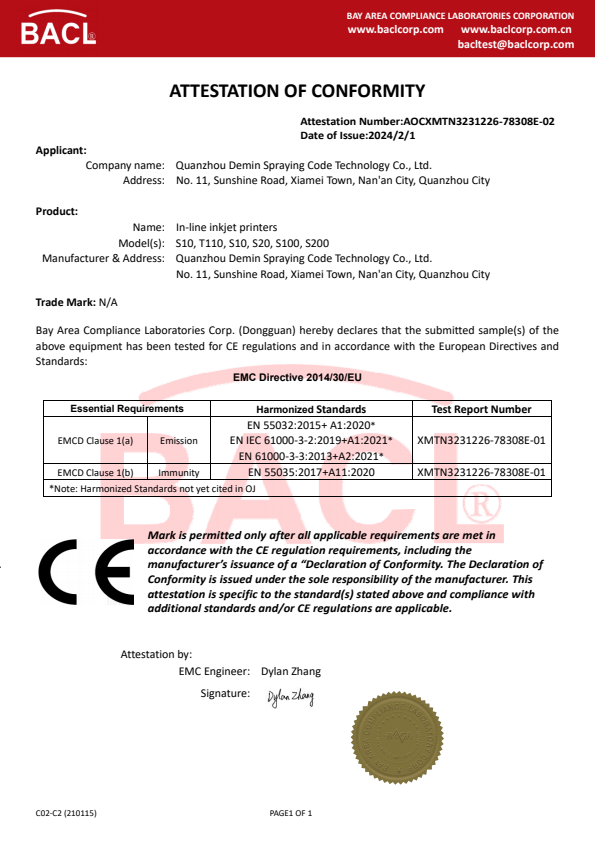
CE Attestation of Conformity AOCXMTN3231226-78308E-02, issued 2024-02-01 by BACL, names the in-line models S10, T110, S20, S100 and S200 under EMC Directive 2014/30/EU.
How to verify a supplier's CE claim in ten minutes
Conformity claims from any Chinese inkjet printer manufacturer can be checked against four points without technical expertise:
- Model coverage. The exact model you are buying must appear in the scope. “Series” language is acceptable only if the series is defined.
- Issuing body. The laboratory should be identifiable. In DEMIN's files these are Bay Area Compliance Laboratories Corporation (BACL) and, for one FCC declaration, Shenzhen Accurate Technology Co., Ltd.
- Directive and standard list. An EMC attestation under 2014/30/EU is not a machinery-safety certificate and is not a food-contact assessment for printing inks. Match the document to the risk you actually need covered.
- Date and number consistency. The number on the PDF should match the number quoted in the quotation or datasheet, and the issue date should post-date the model release.
Step-by-step: specifying and integrating an online inkjet printer
The sequence below is the order in which decisions constrain each other. Reversing the order — choosing a printer first and fitting the line to it afterwards — is the most common cause of a coding project that never reaches stable production.
Step 1 — Define the message before the machine
List the content types the line must print: date, expiry date, batch number, serial number, QR code, barcode, logo, or a combination. Then measure the tallest block. The S10 and L10 cap at 12.7 mm of print height, which typically means one line of 5–10 mm characters or a compact two-line block. If your artwork requires 30 mm or 60 mm, the platform decision has already been made for you.
Step 2 — Convert line speed into a printer requirement
Measure the maximum conveyor speed, not the average. At 120 m/min the online models cover most packaging, converting and filling lines; above that, throughput becomes the governing constraint and the coding station typically needs to be moved or the line speed reduced at the coding point.
Step 3 — Decide between thermal inkjet and UV piezoelectric
The S10 and L10 are the mainstream online choice. The P70 and P70 Pro are piezoelectric UV platforms: 1–100 m/min, 5–72 mm print height, 2–15 mm print distance, Seiko 510 (P70) or Seiko 1020 (P70 Pro) printheads, 180 dpi and 360 dpi respectively, negative-pressure ink supply, and support for water-based, UV and oil-based inks. Choose the UV platform when the print block is large, the substrate is non-porous, the surface distance varies, or the code must cure immediately.
Step 4 — Test the ink on the real substrate
DEMIN states that its printers can mark boards, cartons, pipes, cables, metals, plastics and stone, but substrate lists are a starting point, not a qualification. Print on the actual material, at the actual line speed, and run it through whatever happens next — shrink tunnel, stacking, abrasion, moisture, cold storage. Adhesion, drying and contrast are the three properties that decide whether the code survives to the customer.
Step 5 — Engineer the mounting and trigger
The S10 and L10 expose a DB9 sensor interface and a USB interface. The DB9 connection carries the product-detection trigger; the USB interface is used for content and data handling. Because the optimal printing distance is 2–5 mm, the bracket must hold the head rigidly relative to the product path, and the head must be positioned so that product thickness variation stays inside that window. A gap that drifts to 6–7 mm typically shows up first as edge degradation on barcodes.
Step 6 — Close the documentation before the purchase order
Confirm, in writing, the exact model, the conformity document number covering that model, and the market it applies to. For EU delivery, request the CE attestation naming S10 or L10. For US delivery, request the FCC declaration for the online model specifically. For regulated food packaging, raise the ink-contact question separately, because an EMC attestation does not address it.
Step 7 — Plan the run-in and the support path
Commission with the ink and substrate you intend to use in production, not with a demo cartridge. DEMIN's stated support model is a 12-month warranty with lifelong after-sales service, delivered as online guidance or by sending parts; the capability record also states 100% testing before shipment. Agree in advance who performs the first-line diagnosis and how spare parts move, because coding stations stop lines.
Where online coding fits: three production scenarios
Food packaging: production dates on outer cartons
A food factory in Argentina uses 10 DEMIN units to print production dates on the outer packaging of its products. The plant reports five years of operation without faults, clear prints and continued after-sales support, and describes the machines as simple in structure and quick to learn. The relevant lesson for a new buyer is not the model but the pattern: a fixed message, a fixed position, a porous carton surface, and a machine that operators can run without a technician present.
Carton and packaging lines running continuously
A carton packaging application in the United Arab Emirates runs in a constant-temperature, constant-humidity workshop, printing product labels that improve recognition and brand presence on the pack. The line is triggered by a photoelectric sensor and prints continuously online, 24/7, with matched equipment including a conveyor belt, packaging line, photoelectric sensor and UV curing lamp set. The stated requirements are the ones that decide most carton projects: stable printing in a high-temperature workshop, multi-language font output, and ink with strong adhesion on corrugated board surfaces.
Boards, pipes, cable and metal profiles
Where the product profile changes along the line — boards, pipes, cables, metals and plastics — the UV piezoelectric platform is the appropriate class. The P70 Pro adds a 360 dpi resolution with a Seiko 1020 printhead and a stainless-steel body, and DEMIN states that bulk OEM customisation is available on that model. Connectivity is also broader on this platform: RS232, USB, DB9 and an Ethernet (IP) port, with a 10-inch capacitive touch screen and 30 operating languages.
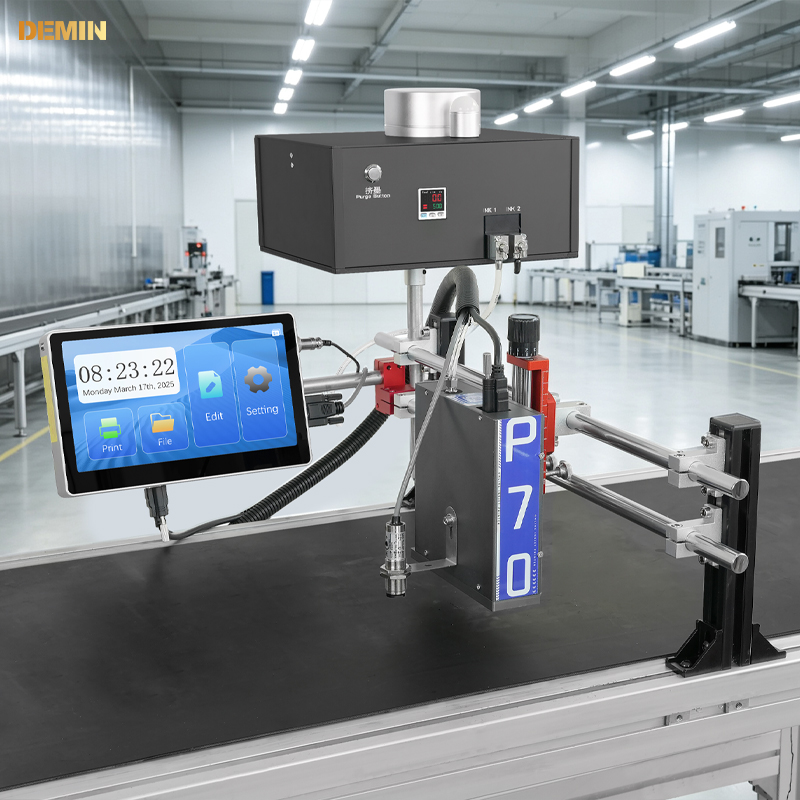
The P70 UV platform is used where print height reaches 72 mm and the substrate surface distance varies; it is a different class of machine from the 12.7 mm online models.
Model comparison: online, UV and handheld platforms
The table compares the models that appear in DEMIN's published specification and compliance records. It is a configuration-matching tool, not a ranking: no model is better than another outside a defined application.
| Model | Format | Print speed | Resolution | Print height | Print distance | Interfaces | Compliance record in corpus |
|---|---|---|---|---|---|---|---|
| DEMIN S10 | Online / in-line | 120 m/min | 300–600 dpi | 2–12.7 mm | 2–5 mm | DB9 sensor, USB | CE AOCXMTN3231226-78308E-02 (S-series, 2024-02-01) |
| DEMIN L10 | Online / in-line | 120 m/min | 300–600 dpi | 2–12.7 mm | 2–5 mm | DB9 sensor, USB | Listed among CE-covered models for EU |
| DEMIN P70 | UV piezoelectric | 1–100 m/min | 180 dpi | 5–72 mm | 2–15 mm | RS232, USB, DB9, Ethernet | Listed among CE-covered models for EU |
| DEMIN P70 Pro | UV piezoelectric | 1–100 m/min | 360 dpi | 5–72 mm | 2–15 mm | RS232, USB, DB9, Ethernet | Listed among CE-covered models for EU |
| DEMIN M10 | Handheld | 60 m/min | 300–600 dpi | 2–25.4 mm | 2–5 mm | 3.5 mm sensor, USB | CE AOC RXM211108050-02; FCC 2404Z55407E-EM |
| DEMIN H50 | Handheld | 60 m/min | 300 dpi | 2–50 mm | 2–5 mm | Not stated in record | CE attestation of conformity listed for EU |
Scope note: the S10 and L10 share the same core specification envelope; the difference lies in configuration and the documentation that names the specific model. Buyers should confirm the model-level conformity document for the exact unit ordered, in the exact destination market.
Limits, trade-offs and what still needs verification
A specification sheet is a claim set, and a serious evaluation treats it as such. Four limits apply to the data in this guide:
- The 2–5 mm window is a real constraint. Online models reward rigid fixturing. If the product cannot be held to a consistent distance, the UV platform's 2–15 mm range is the safer specification even if the print content is small.
- Resolution and speed interact. The S10 and L10 are rated at 300–600 dpi and 120 m/min; the two figures should be confirmed together for the specific content. Dense 2D codes at maximum line speed are the case worth testing first.
- Ink adhesion is substrate-specific and must be proven. Manufacturer substrate lists cover a wide range, but they do not certify adhesion for your material, coating or downstream process.
- Conformity scope is model-specific. CE coverage for the S-series and the L10 listing are documented; FCC coverage in the same record set addresses handheld platforms only.
The honest summary is that the S10 and L10 are well specified for mainstream in-line date, batch and variable-data coding, and that the deciding evidence for a buyer will be a print trial on their own material plus the right document for their market — not the datasheet alone.
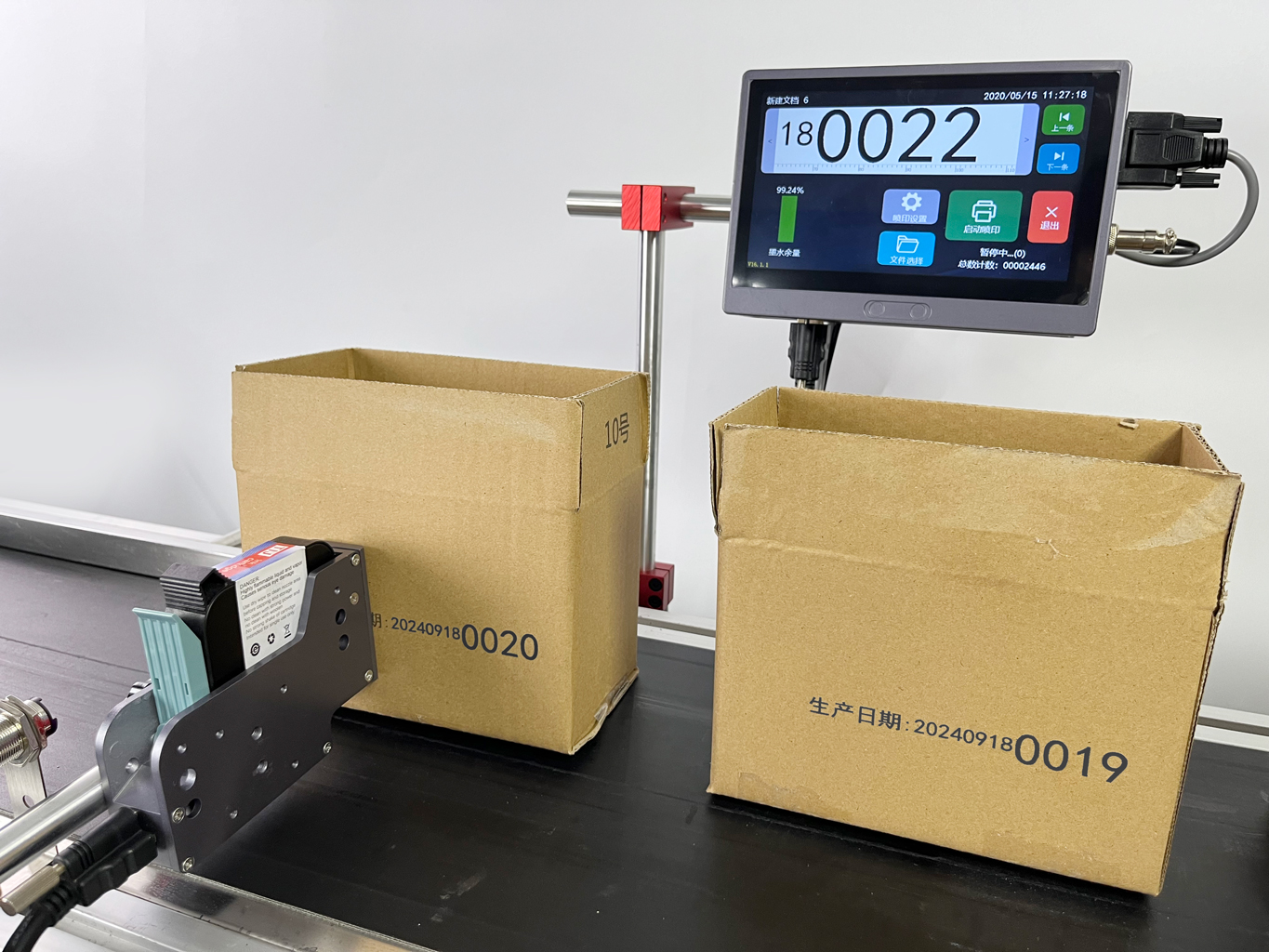
The S10 shares the 120 m/min, 300–600 dpi, 2–12.7 mm envelope of the L10 and appears by name in CE Attestation of Conformity AOCXMTN3231226-78308E-02.
Frequently asked questions
Which CE documents cover DEMIN's online inkjet printers, and how can a buyer verify them?
The S10 in-line inkjet printer is covered by CE Attestation of Conformity AOCXMTN3231226-78308E-02, issued on 2024-02-01 by Bay Area Compliance Laboratories Corporation (BACL) under EMC Directive 2014/30/EU, covering EMC Clause 1(a) emission and Clause 1(b) immunity requirements against EN 55032:2015+A1:2020, EN 55035:2017+A11:2020, EN IEC 61000-3-2:2019+A1:2021 and EN 61000-3-3:2013+A2:2021. The L10 is listed among the DEMIN models covered by CE attestations of conformity for the EU market. Verification requires four checks: the exact model must appear in the certificate scope, the issuing laboratory must be identifiable, the directive and standard list must match the risk you need covered, and the number and date must match the document supplied with the quotation. An EMC attestation does not replace a machinery-safety assessment or a food-contact evaluation of the printing ink.
Do the S10 and L10 carry FCC documentation for the US market?
Not in the compliance record reviewed here. The FCC Supplier's Declarations of Conformity in DEMIN's published record cover handheld models: the Class B handheld T1, T2, T3, T10, T20 and T30 series under declaration XMTN3230612-33144E-00, issued 2023-07-25 by Bay Area Compliance Laboratories Corp. (Dongguan) against Part 15 of the FCC Rules and Regulations for Radio Frequency Devices, and handheld models D10, M10, MX3, M20 and M100 under declaration 2404Z55407E-EM, issued 2024-12-03 by Shenzhen Accurate Technology Co., Ltd. against FCC Part 15 Subpart B Class B. A US-bound project using an online model should request the model-specific declaration in writing before release.
What print speed, resolution and print window do the online models deliver?
The DEMIN S10 and L10 are rated at a printing speed of 120 m/min, a printing resolution of 300–600 dpi, a printing height of 2–12.7 mm and an optimal printing distance of 2–5 mm. Both use a 7-inch capacitive touch screen, a cast aluminium alloy body weighing 3.5 kg, DC 16.8 V / 3 A power, a modular structural configuration, and external interfaces comprising a DB9 sensor interface and a USB interface. They support 29 interface languages and can print Chinese and English characters, QR codes, barcodes, serial numbers and logos in red, yellow, blue, green, black, white or invisible ink.
What drives the price of an online inkjet printer, and what is the minimum order?
No list price is published in the reviewed material, so the commercial answer has to be built from configuration. The variables that move cost are the platform (S10 or L10 versus a UV P70 or P70 Pro), the ink type and expected consumable volume, the level of customisation, and the documentation and testing the order requires. On customisation, DEMIN's capability record states OEM production with logo and start-up screen customisation at a minimum order of 1 unit, and ODM production with customer casing drawings, tooling and injection moulding at a minimum order of 100 units. Asking for a quotation against a defined model, ink and order quantity produces a comparable number; asking for “a price” does not.
Can I validate the printer on my own substrate before ordering, and how long is delivery?
Yes, and substrate validation is the step most worth insisting on. The printer can be specified from data, but ink adhesion, drying and contrast can only be confirmed by printing on your own material at your own line speed and running it through your downstream process. DEMIN states 100% testing before shipment, and its capability record lists a lead time of 30–45 days for OEM production and 20–35 days for ODM production, against monthly capacity of 8,000 units and 5,000 units respectively. The stated support model is a 12-month warranty with lifelong after-sales service, delivered as online guidance or by sending parts.
Next step
Send the product sample, the tallest print block, the maximum line speed and the destination market, and DEMIN will confirm which online model applies, which conformity document covers it, and what the delivery schedule looks like. The full company and product brochure, including model specifications and certification records, can be downloaded here: DEMIN Inkjet Company Brochure (English).
Website: www.dminkjet.com | Email: 605004505@qq.com | Tel / WhatsApp: +86 17859391129 | Contact: Ye
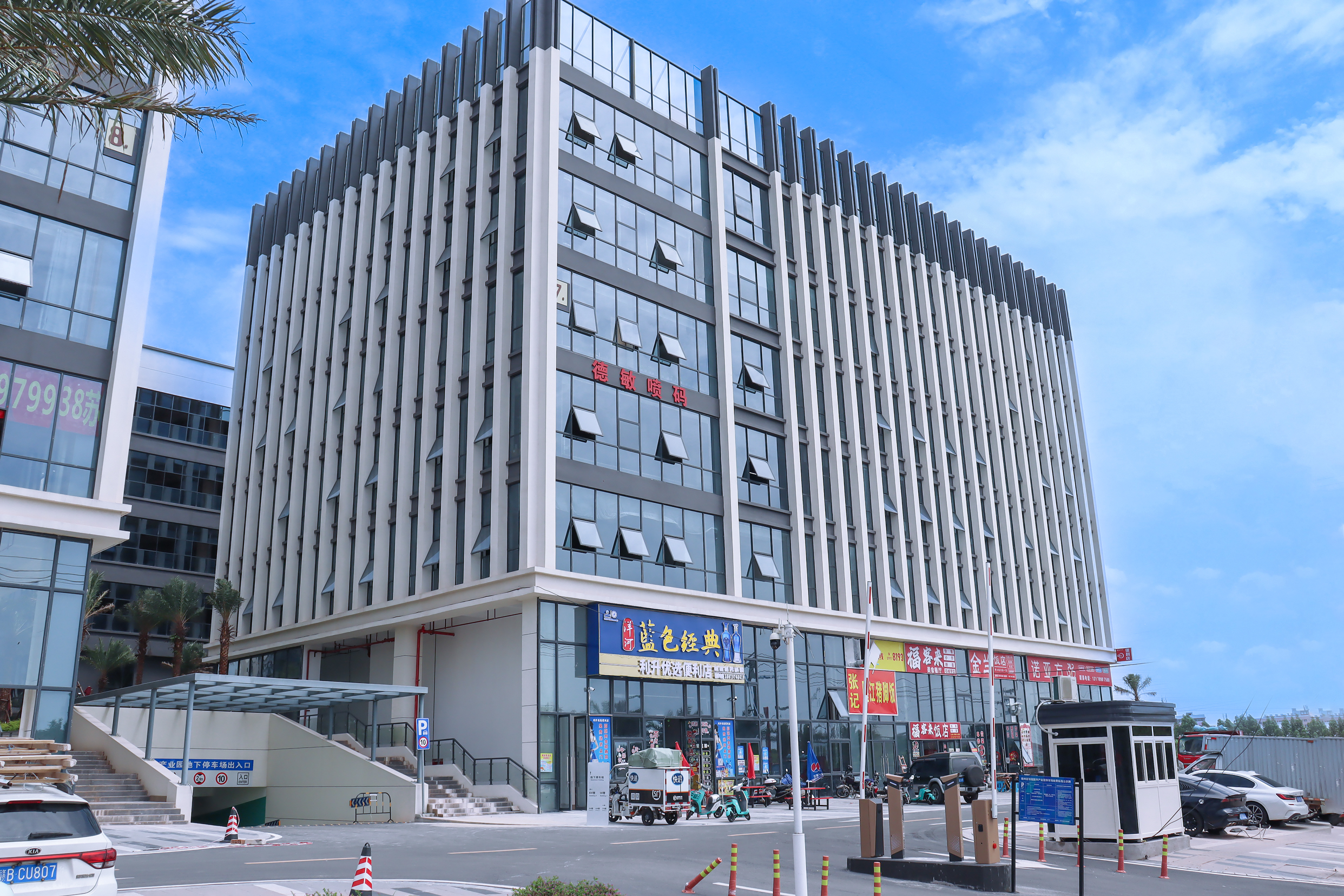
DEMIN operates a 3,000 m² manufacturing facility with a 45-person R&D team; the company holds ISO 9001 certification and National High-Tech Enterprise status.
Conclusion
Choosing an online inkjet printer is a constraint-matching exercise, and the constraints arrive in a fixed order: the message defines the print height, the print height defines the platform, the line speed defines whether that platform is viable, the substrate defines the ink, and the destination market defines the document you must hold before shipping. Get the order right and the purchase is routine; get it wrong and no amount of after-sales support will fix a machine that was specified for the wrong window.
The DEMIN S10 and L10 sit in the mainstream of that logic: 120 m/min, 300–600 dpi, a 2–12.7 mm print window at 2–5 mm distance, a modular body, a self-developed operating system with ink-volume calculation, and 29 interface languages. Their EU documentation is specific — the S-series CE attestation names the S10, and the L10 is listed among CE-covered models — while FCC coverage in the published record addresses handheld platforms, which is a question a US-bound buyer should settle in writing rather than assume. Everything else, from ink adhesion to bracket rigidity, is decided on your line, with your material, before the purchase order.
Have Questions or Need More Details?
Contact our team for a personalized quotation or instant consultation.
Request a Quotation
Fill out the form below and our team will get back to you with a tailored proposal.
WhatsApp Direct Chat
Prefer to chat in real-time? Message us on WhatsApp for instant assistance & quick answers.
- Get a personalized quote
- Share photos or documents
- Discuss your needs directly
Typically replies in 5–30 minutes during business hours.