Handheld vs. Online vs. Piezoelectric Inkjet Printers: A Buyer Comparison Guide
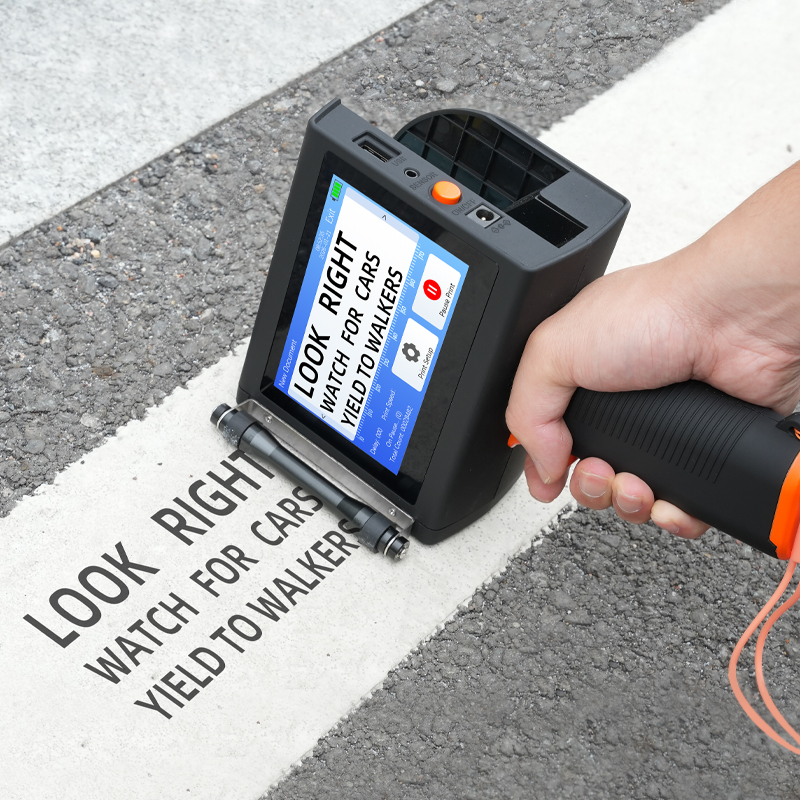
DEMIN H50 handheld inkjet printer: 2–50 mm print height, 2–5 mm optimal distance, 60 m/min, ABS and metal body.
The format decision comes before the specification decision. Handheld, online and piezoelectric inkjet printers are routinely compared on print height, resolution and speed, yet none of those numbers decides which format belongs on a given production line. What decides it is how the product is presented to the printhead: carried by hand past a portable unit, moved by a conveyor past a fixed online head, or driven at line speed past a piezoelectric head with a wider print envelope.
This guide compares the three formats DEMIN manufactures — handheld units (M10 and H50), online inkjet printers for continuous line integration (S10 and L10), and the P70 piezoelectric inkjet printer — using the published model data for each. Every specification below is drawn from that model data. The article closes with a decision matrix keyed to substrate, line speed and automation level, so a buyer can map a format to a real production scenario rather than to a datasheet ranking.
Problem definition: why format mismatches survive the quotation stage
A format mismatch almost never appears during supplier comparison. It appears in production, after the unit is installed, when the marking job turns out to be structurally unsuited to the hardware. Three patterns account for most of these failures.
The handheld unit on a fast line. A portable inkjet printer is specified at a 2–5 mm optimal printing distance. That distance is maintained by the operator, which is acceptable for static goods and batch work but becomes the limiting factor when products arrive at conveyor speed. Print quality degrades before the machine fails, so the problem is often misdiagnosed as an ink or maintenance issue.
The online unit asked for large characters. Online models S10 and L10 print at 2–12.7 mm height. Buyers who need a multi-line or large-character mark on corrugated cartons frequently discover this ceiling only after the integration is complete.
The piezoelectric unit bought for a job a handheld could do. A fixed piezoelectric head with a 5–72 mm envelope, negative-pressure ink supply and Ethernet connectivity carries integration effort that a low-volume, manually presented job does not require.
A second, quieter mismatch concerns colour. All three formats print in a single colour per pass, with six ink colours normally available: red, yellow, blue, green, black and white. A buyer expecting a multi-colour logo in one print run has already selected the wrong category, whichever format they choose.
Industry background: one market, three production realities
The industrial inkjet segment is large and structurally split. Global Market Insights values the industrial inkjet printer market at USD 5.6 billion in 2025, and places the food and beverage vertical at 26% of that segment. Grand View Research reports continuous inkjet (CIJ) at 38.4% of inkjet technology revenue share in 2025. Smithers projects Asia Pacific drawing level with North America in global inkjet volume by 2026 and leading by 2031.
Those figures describe demand concentration, not format preference. High-throughput packaging and beverage lines pull toward continuous, fixed-head systems; distributed operations, mixed-size cartons, warehouse relabelling and short production runs keep handheld demand alive; and wide-mark industrial coding on pipes, cable and board drives piezoelectric configurations.
The integration expectation around coding equipment has also risen. China's National Press and Publication Administration standard defines printing smart manufacturing as the deep integration of new-generation information and communication technology with advanced manufacturing technology across design, production, management and service. For a buyer, that translates into a practical question about the coding device: does it sit on the line as a standalone marker, or does it expose an interface that the plant network can reach? The P70 answers that question with RS232, USB, DB9 and Ethernet ports; the handheld and online units answer it with sensor and USB interfaces.
Detailed solution: how each format behaves in production
Handheld format: the printhead moves, the product does not
A handheld inkjet printer is a self-contained marking unit. The M10 weighs 520 g, runs from a DC 8.4 V, 2500 mAh lithium battery and carries a 4.3-inch capacitive touch screen. Its print height is 2–25.4 mm at 300–600 DPI, its optimal printing distance is 2–5 mm, and its maximum printing speed is 60 m/min. Interface options are a 3.5 mm sensor port and a USB port, and the body is ABS plastic.
The H50 is the heavier, wider-mark alternative at 950 g in an ABS and metal body. It prints 2–50 mm at the same 2–5 mm optimal distance and the same 60 m/min maximum speed. The practical trade-off between the two is explicit: the M10 gives 520 g of one-hand portability inside a 25.4 mm envelope, while the H50 gives roughly double the mark height for 430 g more weight.
Both models are documented as supporting date coding, batch coding, serial numbers, QR codes, barcodes and logos, and both list Chinese, English, Russian, Arabic, French, Vietnamese and 29 further languages. A 3.5 mm sensor port on the M10 does not convert a handheld unit into a line-integrated printer: the 2–5 mm working distance still has to be held by the presentation method, whether that is an operator or a fixture.
Online format: the line moves, the head stays fixed
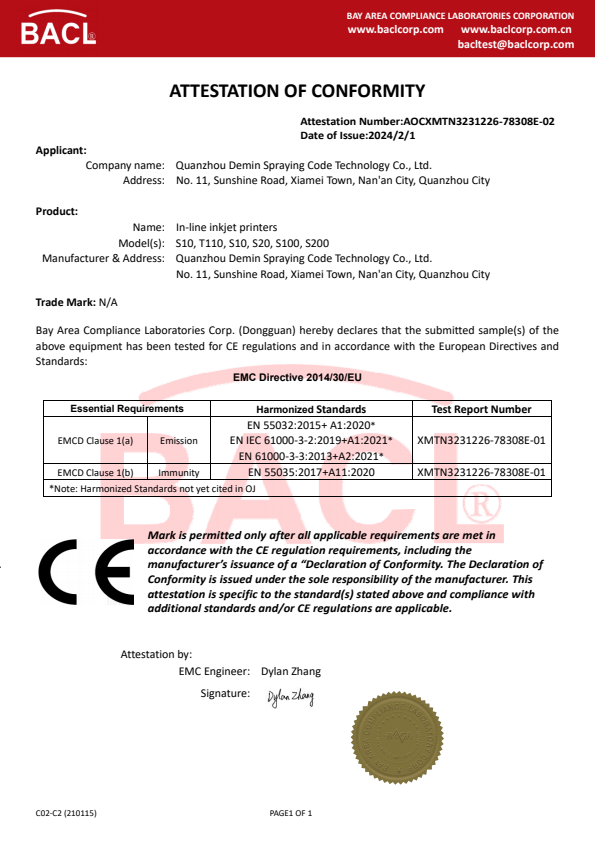
CE Attestation of Conformity AOCXMTN3231226-78308E-02, issued 1 February 2024, covering the in-line model group under EMC Directive 2014/30/EU.
The S10 and L10 are fixed-head online inkjet printers intended for automatic inkjet coding on a moving line. Both weigh 3.5 kg in a cast aluminium alloy body, carry a 7-inch capacitive touch screen and run from DC 16.8 V, 3 A. Print height is 2–12.7 mm at 300–600 DPI, optimal printing distance is 2–5 mm, and maximum printing speed is 120 m/min — the highest linear speed of the three formats in this comparison. Interfaces are a DB9 sensor interface and a USB port.
The operative integration detail is triggering. In DEMIN's documented carton-packaging scenario, the printer operates in a photoelectric-sensor-triggered, 24/7 continuous online automatic printing mode, matched with a conveyor belt, a packaging production line and a photoelectric sensor. That is the essential difference from the handheld format: the line supplies the timing signal and the constant distance, so throughput is limited by the machine and the line rather than by the operator.
The 2–12.7 mm height ceiling is the constraint to check first. It covers date codes, batch codes, ingredient lists, barcodes and compact logos on packaging film, labels, cartons and kraft paper, but it does not cover large-character marking.
Piezoelectric format: a fixed head with a wider envelope and three ink chemistries
The P70 is a piezoelectric inkjet (PIJ) printer built around a Seiko 510 printhead with 510 nozzles and a 35 picoliter drop size, firing at 8.29 kHz. It prints 5–72 mm in height, at 180 dpi, over a printing distance of 2–15 mm and at a speed of 1–100 m/min. Power consumption is 20 W from DC 16.8 V, 5 A, and the control interface is a 10-inch capacitive touch screen running the machine operating system.
Two capabilities separate it from the other formats. The first is ink chemistry: the P70 accepts water-based, UV and oil-based inks, delivered through a negative-pressure ink supply system, and operates between 0 °C and 50 °C at 10–90% RH. Where UV ink is used, the packaging-line setup in DEMIN's documented scenario includes a UV curing lamp set. The second is substrate range: boards, cartons, pipes, cables, metals and plastics, with printable content covering text, images, serial numbers, QR codes, barcodes, dates and tables.
Its external interfaces are RS232, USB, DB9 and Ethernet (IP). That interface set is what makes the P70 the format to select when the coding device has to report into a plant network or accept variable data from a host system rather than from a hand-held screen. A 360 dpi variant, the P70 Pro with a Seiko 1020 printhead, is also listed in the range for buyers who need higher resolution than the P70's 180 dpi.
The shared constraint: single colour, six standard inks
Across handheld, online and piezoelectric formats, printing is single colour per pass. Six ink colours are normally available — red, yellow, blue, green, black and white — and the M10, H50, S10 and L10 model listings additionally include invisible ink in their colour sets. The P70 adds a chemistry choice (water-based, UV, oil-based) rather than a colour choice.
This constraint changes real procurement decisions. A buyer who needs a red warning block and a black date code on the same carton is not choosing between formats; they are choosing between two passes, two units, or a different printing process. Establishing the colour requirement before the format shortlist prevents the most expensive kind of rework, because colour is the one specification that no upgrade path inside this family resolves.
Step-by-step breakdown: six checks that settle the format question
1. Fix the marking content and the number of lines
Write down exactly what has to appear: production date, expiry date, batch number, serial number, QR or DataMatrix code, ingredient list, logo, or a table. Then count the lines. The content determines the height requirement, and the height requirement eliminates formats before any commercial discussion starts. DEMIN's own selection guidance states that the more content you need to print, the larger the print height you should select.
2. Measure the print height you actually need
Convert the content into a millimetre figure. Single-line date and batch codes typically fit well inside the online unit's 2–12.7 mm window. Multi-line blocks or large characters push the requirement into the M10's 25.4 mm, the H50's 50 mm, or the P70's 72 mm. This single measurement separates the online format from the rest of the range more decisively than any other specification.
3. Convert line speed into a format requirement
Establish the maximum speed at which products pass the head. The published maxima are 60 m/min for the M10 and H50, 120 m/min for the S10 and L10, and 1–100 m/min for the P70. If the line runs faster than the format's maximum, the result is not a slower line — it is an unreadable mark at normal line speed. Where the line runs at or below 60 m/min, the handheld format remains viable on speed alone, and the decision falls back to presentation and volume.
4. Match the ink chemistry to the substrate
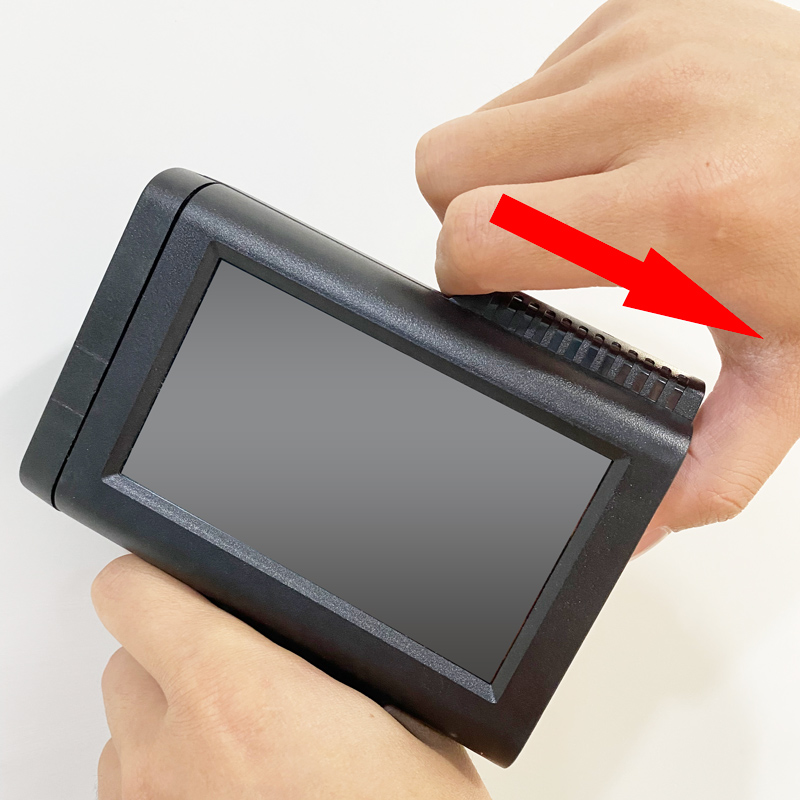
Cartridge handling step one on a TIJ handheld unit: the transparent protective cover is opened before the cartridge is inserted at an angle and secured with the lever.
DEMIN's printer range is documented as printing on carton, plastic, metal, glass, wood, woven fabric and other surfaces, while exact adhesion and drying behaviour depend on the surface and the ink. The P70's three ink chemistries exist precisely because one ink does not serve board, cable jacket and plastic film equally. For corrugated carton work in a high-temperature workshop, DEMIN's documented scenario calls for ink with strong adhesion to the corrugated surface and support for multi-language font output.
Maintenance belongs in the same step. The documented risk profile for this equipment class is nozzle clogging, ink leakage and blurred marking, triggered by incompatible ink, missing regular cleaning, or operation in dusty or extreme-temperature conditions. The stated mitigation is matched ink plus regular nozzle cleaning, with clogged nozzles cleaned or replaced and ink lines inspected for leakage. A buyer who cannot commit to that routine should weight format reliability and service response more heavily than purchase price.
5. Confirm the compliance file for the exact model
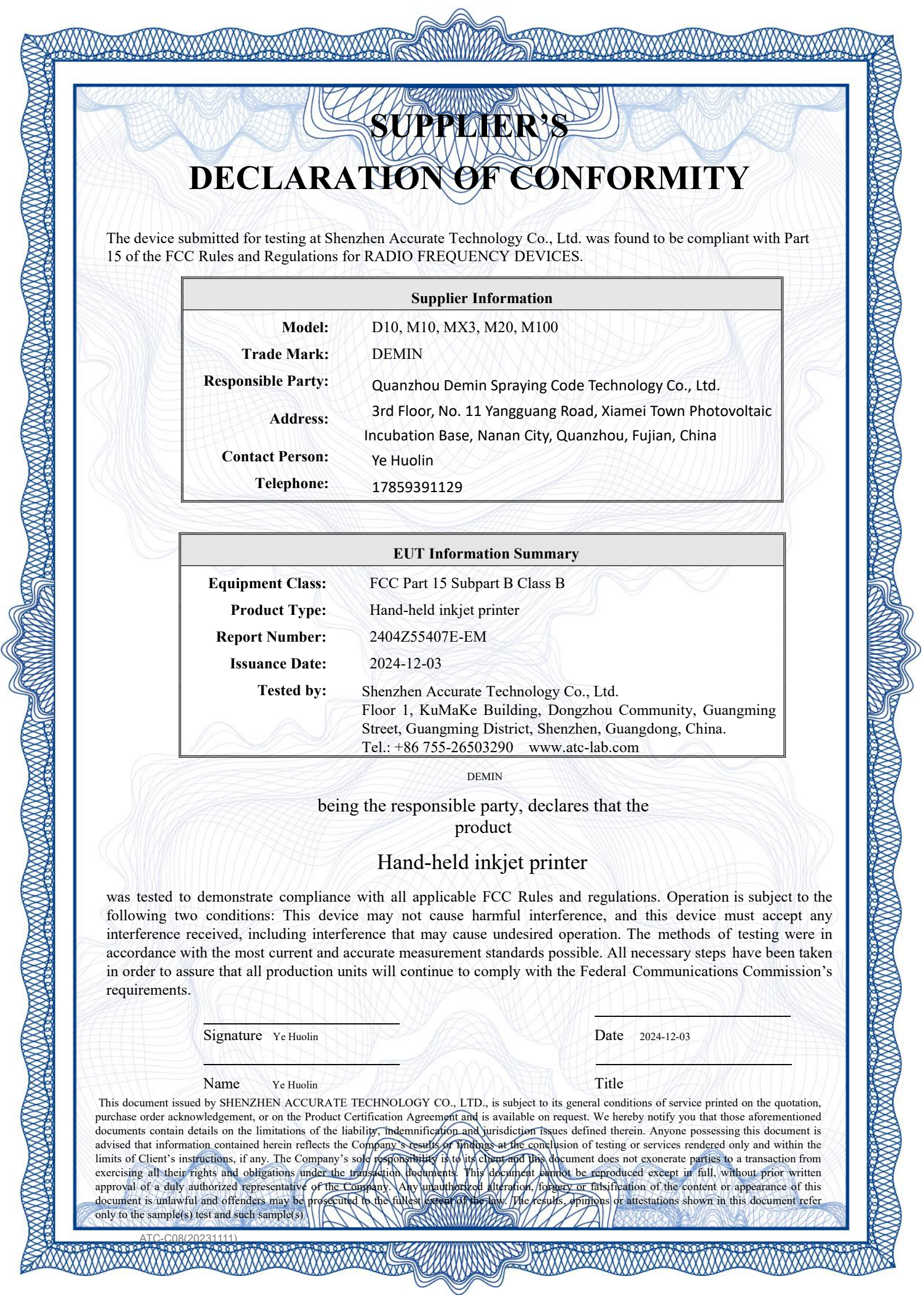
FCC Supplier's Declaration of Conformity 2404Z55407E-EM, issued 3 December 2024, covering handheld models D10, M10, MX3, M20 and M100 under FCC Part 15 Subpart B Class B.
Compliance is declared by model group, not by brand, so the check is a document check. The handheld group is covered by CE Attestation of Conformity AOC RXM211108050-02, issued 7 January 2022 under EMC Directive 2014/30/EU for models M10, MX3S, M20 and D10, and by CE AOCXMTN3231012-59588E-02, issued 31 October 2023, for models T1, T2, T3, T10, T20 and T50. For the United States, FCC Supplier's Declaration of Conformity 2404Z55407E-EM, issued 3 December 2024, covers D10, M10, MX3, M20 and M100, and FCC XMTN3230612-33144E-00, issued 25 July 2023, covers T2, T3, T10, T20, T30 and T1.
The in-line group is covered by CE AOCXMTN3231226-78308E-02, issued 1 February 2024, for models S10, T110, S20, S100 and S200. The P70 is not named inside the declared model scopes of the documents summarised here, so a buyer sourcing that format should request the model-specific declaration for the destination market and keep it in the purchasing file rather than assuming coverage from the family name.
6. Set the commercial frame: MOQ, lead time and warranty
Format selection is only complete when the order structure is known. DEMIN operates two documented production modes. Under OEM, customisation covers the logo and the startup screen, with an MOQ of 1 unit, a lead time of 30–45 days, a monthly capacity of 8,000 units, 100% testing, and after-sales support through online guidance and sending parts, serving the EU, Middle East and the Americas. Under ODM, the buyer supplies casing drawings, DEMIN opens the injection mould and produces the buyer's own machine, with an MOQ of 100 units, a lead time of 20–35 days and a monthly capacity of 5,000 units. A 12-month warranty and lifelong after-sales service apply across the models.
Use cases: matching format to production scenario
Food and beverage packaging: date and batch coding
This is the highest-volume application in the segment, and it splits by line architecture rather than by product. A filling line that already carries products past a fixed point at constant spacing uses an online S10 or L10 triggered by a photoelectric sensor, printing 2–12.7 mm date codes continuously. A plant packing assorted cartons, or a co-packer running several short batches a day, uses an M10 or H50 where the operator presents each carton. The handheld format also covers warehouse relabelling and overprinting of pre-printed packaging, which a fixed line cannot reach.
Cartons, kraft paper and ingredient lists
Corrugated carton work is where the height decision becomes visible. A single-line batch code fits the online window; an ingredient list or a multi-line block does not. In DEMIN's documented carton-packaging scenario the operating requirement is stable printing in a high-temperature workshop, multi-language font output, and ink with strong adhesion on the corrugated surface — a combination that points to a fixed-head format with the correct ink rather than to the fastest unit available.
Industrial goods: pipes, cables, metal and plastic
Extruded cable, pipe, board and metal parts present a different problem: the mark is wide, the surface is unforgiving, and the line does not stop. The P70's 5–72 mm height, 2–15 mm working distance, three ink chemistries and Ethernet interface are aimed at exactly this configuration, where variable data may arrive from a host system and the marking device is expected to sit on the plant network.
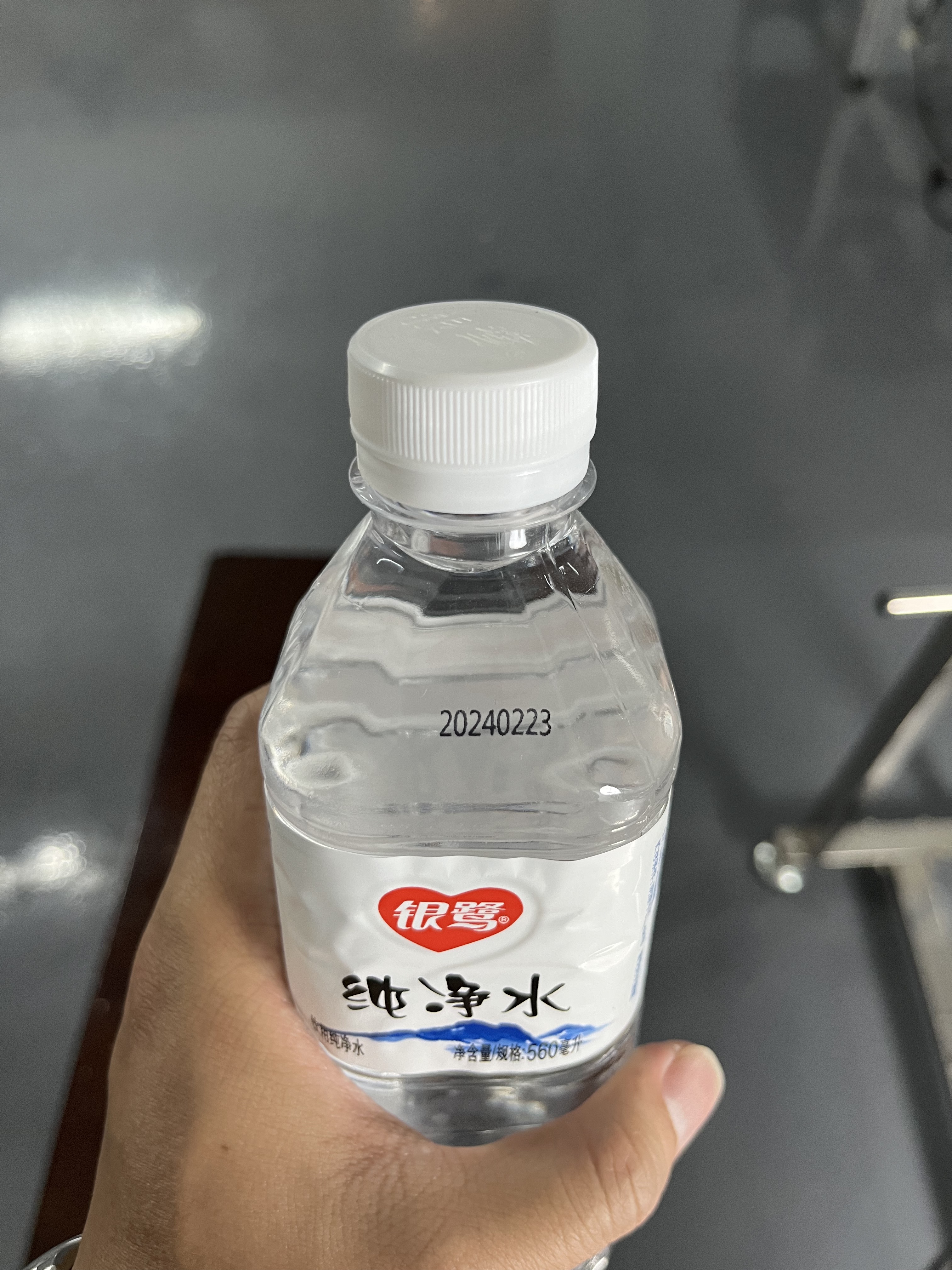
Print result recorded in DEMIN's food-industry case file: date coding on a mineral water bottle.
Field case: ten handheld units in an Argentine food factory
A food factory in Argentina operates ten handheld units for printing the production date on the outer packaging of its products. The units have been in service for five years, and the reported result is long-term operation without faults, clear prints and responsive after-sales service; the buyer's stated highlight is a simple structure, a compact design and quick, easy operation. The case illustrates the format logic rather than contradicting it: outer packaging presented manually, a date code within the handheld envelope, and a volume that does not justify a fixed installation.
Comparison table: verified specifications across the three formats
| Parameter | Handheld M10 | Handheld H50 | Online S10 / L10 | Piezoelectric P70 |
|---|---|---|---|---|
| Print height | 2–25.4 mm | 2–50 mm | 2–12.7 mm | 5–72 mm |
| Resolution | 300–600 DPI | — | 300–600 DPI | 180 dpi (P70 Pro: 360 dpi) |
| Maximum print speed | 60 m/min | 60 m/min | 120 m/min | 1–100 m/min |
| Optimal print distance | 2–5 mm | 2–5 mm | 2–5 mm | 2–15 mm |
| Weight | 520 g | 950 g | 3.5 kg | — |
| Body material | ABS plastic | ABS and metal | Cast aluminium alloy | Aluminium |
| Screen | 4.3-inch capacitive | — | 7-inch capacitive | 10-inch capacitive |
| Power | DC 8.4 V, 2500 mAh battery | — | DC 16.8 V, 3 A | DC 16.8 V, 5 A, 20 W |
| Interfaces | 3.5 mm sensor port, USB | — | DB9 sensor interface, USB | RS232, USB, DB9, Ethernet |
| Printhead | — | — | — | Seiko 510, 510 nozzles, 35 pl |
| Ink | Single colour; red, yellow, blue, green, black, white, invisible | Single colour | Single colour; red, yellow, blue, green, black, white, invisible | Single colour; water-based, UV or oil-based |
| Operating environment | — | — | — | 0–50 °C, 10–90% RH |
| Typical substrates | Carton, plastic, metal, glass, wood, woven fabric | Carton, plastic, metal, glass, wood, woven fabric | Packaging film, labels, cartons, kraft paper | Boards, cartons, pipes, cables, metals, plastics |
Specifications as published for each model. A dash marks a parameter that is not stated in the supplied model data for that unit; it is not a zero or a limitation.
Decision matrix: substrate, speed and automation level
| Production scenario | Substrate | Line speed | Automation level | Format to select |
|---|---|---|---|---|
| Date and batch codes on manually presented outer packaging; mixed carton sizes; short runs | Carton, kraft paper, plastic, glass | Static or walking pace | Manual, operator held | M10 (2–25.4 mm, 520 g) |
| Large-character mark on cartons or drums; two lines or more | Corrugated carton, board, woven bags | Up to 60 m/min | Manual, operator held | H50 (2–50 mm, 950 g) |
| Continuous packaging or filling line with sensor triggering | Packaging film, labels, cartons, kraft paper | Up to 120 m/min | Photoelectric sensor, 24/7 automatic | S10 or L10 (2–12.7 mm) |
| Wide mark or variable data on extruded or industrial goods | Pipes, cables, metals, plastics, boards | 1–100 m/min | Networked, Ethernet or RS232 host data | P70 (5–72 mm) |
| Multi-colour logo in a single pass | Any | Any | Any | Outside this family; single colour only |
Use the matrix as a filter, then verify the selected configuration against a test print on the actual substrate before ordering.
FAQ
Which CE and FCC documents cover the handheld, online and P70 models?
Coverage is declared by model group. For handheld units, CE Attestation of Conformity AOC RXM211108050-02, issued 7 January 2022 under EMC Directive 2014/30/EU, covers M10, MX3S, M20 and D10, and CE AOCXMTN3231012-59588E-02, issued 31 October 2023, covers T1, T2, T3, T10, T20 and T50. For the United States, FCC Supplier's Declaration of Conformity 2404Z55407E-EM, issued 3 December 2024 under FCC Part 15 Subpart B Class B, covers D10, M10, MX3, M20 and M100, and FCC XMTN3230612-33144E-00, issued 25 July 2023, covers T2, T3, T10, T20, T30 and T1. In-line models S10, T110, S20, S100 and S200 are covered by CE AOCXMTN3231226-78308E-02, issued 1 February 2024. The P70 is not named within the declared scopes listed above, so its model-specific declaration should be requested for the destination market before ordering.
Can the printers be customised for an OEM or private-label programme?
Two documented routes exist. OEM covers logo and startup-screen customisation, with an MOQ of 1 unit, a lead time of 30–45 days, a monthly capacity of 8,000 units, 100% testing, and after-sales support through online guidance and sending parts. ODM goes further: the buyer supplies casing drawings, DEMIN opens the injection mould and produces the buyer's own machine, with an MOQ of 100 units, a lead time of 20–35 days and a monthly capacity of 5,000 units. The documented customisation scope covers branding and housing; the print engine is fixed by model — the P70, for example, is specified with a Seiko 510 printhead and 510 nozzles, and the P70 Pro with a Seiko 1020 head.
What order quantities and lead times apply, and how is the budget framed?
The documented commercial parameters are an OEM minimum order of 1 unit with a 30–45 day lead time, and an ODM minimum order of 100 units with a 20–35 day lead time, produced at monthly capacities of 8,000 and 5,000 units respectively, both with 100% testing. Unit pricing is configuration-dependent and is not published in this guide; the MOQ, lead-time and capacity figures above are the parameters a buyer can plan against when budgeting a first order or a repeat order.
Can a buyer test the format on their own substrate before ordering?
Test printing is the practical way to settle the substrate question, because the range is documented for carton, plastic, metal, glass, wood and woven fabric, while adhesion and drying behaviour vary by surface and by ink chemistry. A trial should reproduce the real conditions: the actual substrate, the real print height and line count, the real line speed, and for the P70 the intended ink type — water-based, UV or oil-based. Where UV ink is used, the packaging-line setup in DEMIN's documented scenario includes a UV curing lamp set. To arrange a test print on your own material, contact DEMIN at 605004505@qq.com or +86 17859391129 before committing to an order.
What warranty and support apply across the three formats?
A 12-month warranty and lifelong after-sales service apply across the models, with support delivered through online guidance and by sending parts. OEM and ODM programmes add production lead times of 30–45 days and 20–35 days respectively. The next step is to send the marking specification — content, print height, substrate, line speed and automation level — so the format and the ink chemistry can be confirmed against a test print rather than against a datasheet.
Conclusion: select the format, then the model
The three formats are not competing answers to one question. A handheld inkjet printer answers how to mark static or manually presented products with minimum installation effort; an online inkjet printer answers how to mark a continuously moving line within a 12.7 mm window at up to 120 m/min; a piezoelectric printer answers how to place a 5–72 mm mark on industrial substrates with selectable ink chemistry and a network interface. Getting the format right makes the model choice short. Getting it wrong makes every later optimisation expensive.
Three checks close the decision safely. First, confirm the print height and the number of lines against the model data, not against a demonstration on a different substrate. Second, confirm the compliance file for the exact model and destination market. Third, confirm the colour requirement, remembering that all three formats print single colour from a standard set of six inks.
DEMIN Inkjet Printer is the brand of Quanzhou Demin Spraying Code Technology Co., Ltd., a manufacturer founded in 2017, operating a 3,000 m² factory with 150 employees and a 45-person R&D team, certified to ISO 9001 and recognised as a National High-Tech Enterprise. The company manufactures the handheld, online and piezoelectric formats compared here and supports OEM and ODM programmes from its base in China.
Match a format to your line
Send the marking content, print height, substrate, line speed and automation level, and DEMIN will confirm which of the three formats fits — and which ink chemistry to test first.
Website: www.dminkjet.com | Email: 605004505@qq.com | Tel / WhatsApp: +86 17859391129
Download the full company brochure with model data and certification references: DEMIN Inkjet Company Brochure (English)
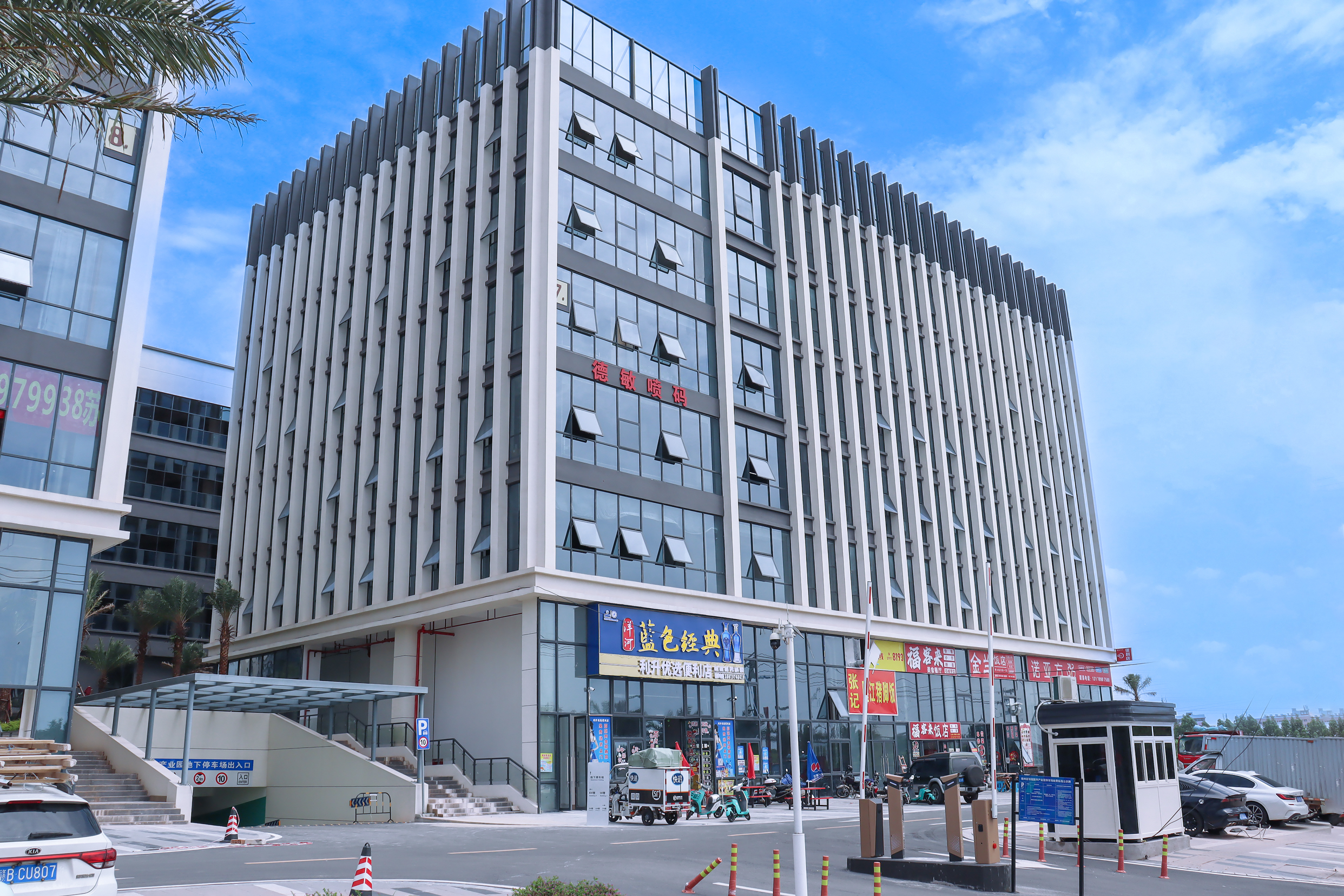
DEMIN manufacturing base: 3,000 m² of production space supporting handheld, online and piezoelectric inkjet printer assembly and testing.
Have Questions or Need More Details?
Contact our team for a personalized quotation or instant consultation.
Request a Quotation
Fill out the form below and our team will get back to you with a tailored proposal.
WhatsApp Direct Chat
Prefer to chat in real-time? Message us on WhatsApp for instant assistance & quick answers.
- Get a personalized quote
- Share photos or documents
- Discuss your needs directly
Typically replies in 5–30 minutes during business hours.