Industrial Inkjet Printer Specification Guide: Certifications, Speed and Substrate Constraints
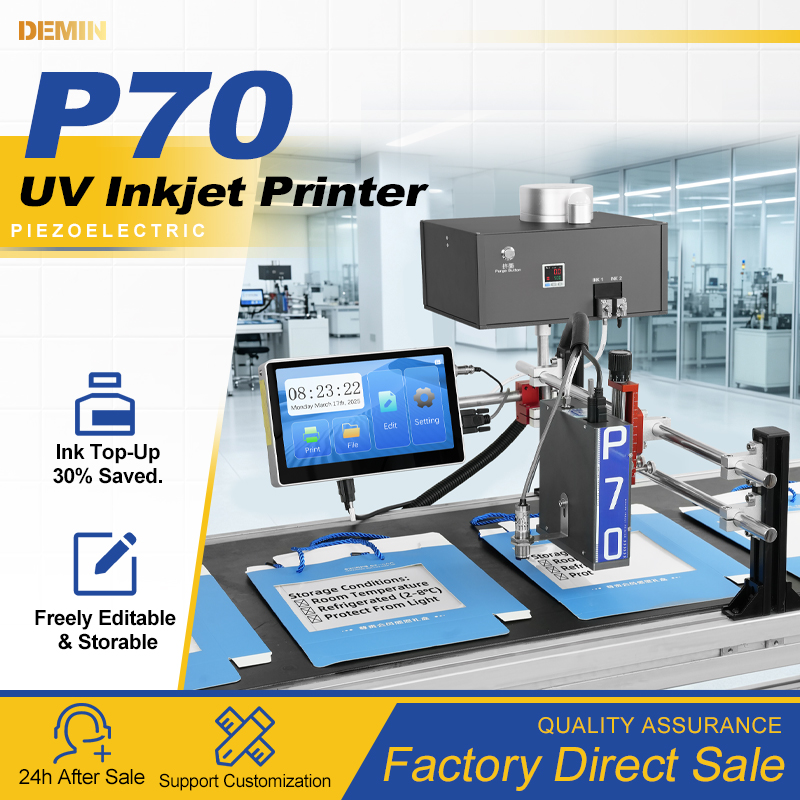
DEMIN P70 UV piezoelectric inkjet printer — a 5–72 mm print height industrial model built for online production line marking.
Problem Definition: Why "Industrial Inkjet Printer" Is a Constraint Problem, Not a Product Category
The phrase industrial inkjet printer covers at least four distinct marking technologies — continuous inkjet (CIJ), thermal inkjet (TIJ), piezoelectric inkjet (PIJ) and UV-curing piezoelectric — plus physical formats ranging from a 520 g handheld unit to a stainless-steel production-line printer with a 10-inch touchscreen. Buying across that range without a constraint framework is how procurement teams end up with a machine that prints perfectly on a test sheet but cannot keep pace with a 120 m/min conveyor, or one that passes EU testing but cannot be placed on the US market without additional documentation.
Three constraints typically decide the shortlist:
- Regulatory scope. Electrical and EMC conformity is model-specific, not brand-wide. A certificate that names models T1, T2, T3, T10, T20 and T50 does not automatically cover an S-series in-line printer, even when both products carry the same trade mark.
- Performance headroom. A printer rated at 120 m/min and 300–600 dpi can support higher line throughput than a 60 m/min handheld unit — but only if print height, print distance and substrate handling are also inside spec.
- Substrate compatibility. Ink adhesion on corrugated carton, kraft paper, plastic, metal, glass, wood or woven fabric is not guaranteed by the printer specification alone. It is the joint result of ink type, surface energy and curing method.
Fail any one of these and the machine is unsuitable for the line, regardless of how strong the individual spec appears in isolation.
Industry Background: Where Industrial Inkjet Sits in the Marking Market
Industrial inkjet printing is one segment of a much larger inkjet market. Grand View Research estimated the total global inkjet printer market — including consumer and desktop devices — at USD 45.2 billion for 2025 and USD 48.0 billion for 2026 (SRC-0001). Global Market Insights, focusing specifically on industrial systems, placed the industrial inkjet printer segment at USD 5.6 billion for 2025 (SRC-0002). The two figures are not comparable: one includes consumer hardware, the other does not. They should not be averaged, combined, or presented as a single market size.
Within the industrial marking category, continuous inkjet (CIJ) remains the largest single technology by revenue share, at 38.4% in 2025 according to Grand View Research (SRC-0001). Food and beverage accounts for 26% of industrial inkjet demand in the same Global Market Insights dataset (SRC-0002) — a share that reflects how much of the installed base performs date, batch and expiry coding on packaging rather than decorative printing.
The regional structure is shifting. Smithers projects Asia Pacific will draw level with North America in global inkjet volume by 2026 and lead by 2031 (SRC-0003). For buyers sourcing from Chinese manufacturers, this has two practical consequences: supply capacity is expanding in the region, and documentation quality — certification records, test reports, technical datasheets — becomes the differentiating criterion rather than component availability.
The Chinese national press and publication industry standard describes "smart manufacturing of printing" as the deep integration of new-generation information and communication technology with advanced manufacturing technology across design, production, management and service (SRC-0011). That framing matters even for buyers who do not operate in China: coding equipment is increasingly evaluated as a connected data-capture device — printing traceable identifiers, not just ink — which raises the bar on interface availability and data handling.
Detailed Solution: How DEMIN Structures Industrial Inkjet Around These Constraints
Quanzhou Demin Spraying Code Technology Co., Ltd. is a Chinese intelligent-manufacturing enterprise founded in 2017. It operates a 3,000 m² factory with approximately 150 employees, a 45-person R&D team and an annual output of roughly 10,000 units. The company reports that around 50% of production is exported, with principal markets in Europe, the Americas and Asia, including the United States, Germany, Brazil, Malaysia, Russia, Pakistan, Arab markets, Armenia, Senegal and Finland.
DEMIN's portfolio (trade mark DEMIN) spans the constraint categories described above:
- Handheld TIJ printers — H50 and M10 — for flexible, low-volume or retrofit marking.
- Online TIJ printers — L10 and S10 — for continuous production-line installation.
- UV piezoelectric printers — P70 and P70 Pro — for wider print heights and UV-curing applications on boards, cartons, pipes, cables, metals and plastics.
Certification scope is documented per model series
Certification is the most frequently mishandled constraint in cross-border procurement. DEMIN's recorded certification portfolio shows coverage granted by model family, not by brand. The table below summarises the documented scope.
| Certificate type | Models covered | Market | Applicable standard | Certificate No. | Issued |
|---|---|---|---|---|---|
| CE Attestation of Conformity (EMC) | T1, T2, T3, T10, T20, T50 | EU | EMC Directive 2014/30/EU; EN 55032:2015+A11:2020+A1:2020; EN 55035:2017+A11:2020; EN IEC 61000-3-2:2019+A1:2021; EN 61000-3-3:2013+A1:2019+A2:2021 | AOCXMTN3231012-59588E-02 | 2023-10-31 |
| CE Attestation of Conformity (EMC, emission + immunity) | S10, T110, S20, S100, S200 | EU | EMC Directive 2014/30/EU; EN 55032:2015+A1:2020; EN 55035:2017+A11:2020; EN IEC 61000-3-2:2019+A1:2021; EN 61000-3-3:2013+A2:2021 | AOCXMTN3231226-78308E-02 | 2024-02-01 |
| CE Certification (EMC) | MX3S, M10, M20, D10 | EU | EMC Directive 2014/30/EU; EN 55032:2015+A1:2020; EN 55035:2017+A11:2020; EN IEC 61000-3-2:2019+A1:2021 | AOC RXM211108050-02 | 2022-01-07 |
| FCC Supplier's Declaration of Conformity | T1, T2, T3, T10, T20, T30 | US | FCC Part 15 (Radio Frequency Devices) | XMTN3230612-33144E-00 | 2023-07-25 |
| FCC Supplier's Declaration of Conformity | D10, M10, MX3, M20, M100 | US | FCC Part 15 Subpart B Class B | 2404Z55407E-EM | 2024-12-03 |
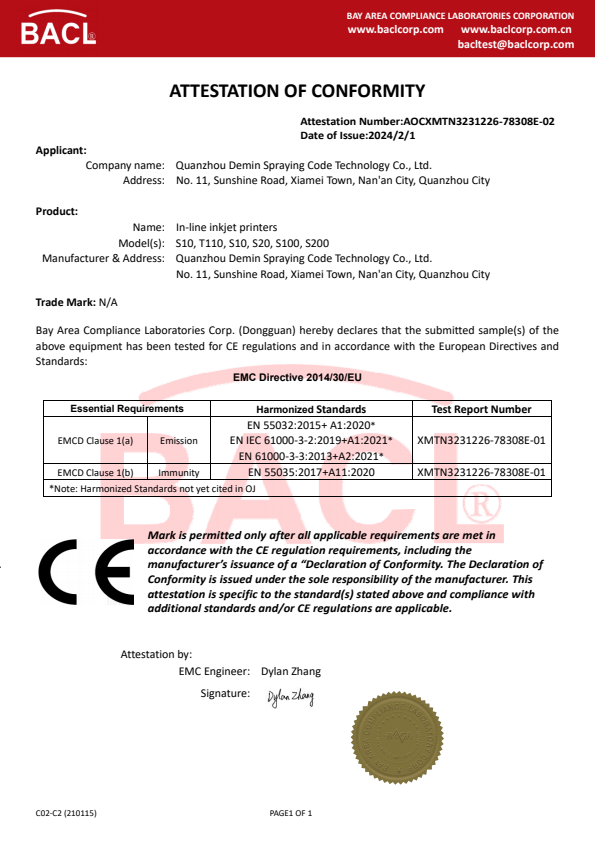
CE Attestation of Conformity AOCXMTN3231226-78308E-02, issued 2024-02-01 by BACL, covering the S10, T110, S20, S100 and S200 in-line inkjet printers under EMC Directive 2014/30/EU.
A separate CE attestation of conformity record also lists the H50 handheld, P70 UV, P70 Pro UV, L10 online and M10 handheld printers as covered for the EU market. Buyers should always match the exact model number they intend to buy against the certificate scope before confirming an order — the presence of the DEMIN trade mark on a certificate does not substitute for that check.
Performance headroom across the range
The fastest platform in the DEMIN range is the online TIJ family. The DEMIN L10 and DEMIN S10 both run at a printing speed of 120 m/min with 300–600 dpi resolution, a 2–12.7 mm print height and an optimal printing distance of 2–5 mm. That combination is built for continuous conveyor operation, where the print head must clear moving cartons without touching them.
The UV piezoelectric platform trades a little resolution for far greater print height. The P70 uses a Seiko 510 printhead with 510 nozzles, a 5–72 mm print height, an adjustable printing distance of 2–15 mm, a 35 picoliter ink drop size and a firing frequency of 8.29 kHz at 180 dpi. The P70 Pro upgrades to a Seiko 1020 printhead at 360 dpi. Both models run from 1 to 100 m/min and support water-based, UV and oil-based inks through a negative pressure ink supply system.
The handheld platforms sit at a lower throughput band. The H50 and M10 both run at 60 m/min. The H50 prints in a 2–50 mm range at 300 dpi with a 5-inch capacitive touchscreen, while the M10 covers 2–25.4 mm at an adjustable 300–600 dpi and weighs 520 g.
Full model specification comparison
| Model | Format | Print height | Resolution | Print speed | Printhead | Body material | Interface |
|---|---|---|---|---|---|---|---|
| DEMIN H50 | Handheld TIJ | 2–50 mm | 300 dpi | 60 m/min | — | ABS + metal | 5-inch capacitive touchscreen |
| DEMIN M10 | Handheld TIJ | 2–25.4 mm | 300–600 dpi | 60 m/min | — | ABS plastic | 4.3-inch capacitive touchscreen; 3.5 mm sensor port; USB |
| DEMIN L10 | Online TIJ | 2–12.7 mm | 300–600 dpi | 120 m/min | — | Cast aluminum alloy | 7-inch capacitive touchscreen; DB9 sensor; USB |
| DEMIN S10 | Online TIJ | 2–12.7 mm | 300–600 dpi | 120 m/min | — | Cast aluminum alloy | 7-inch capacitive touchscreen; DB9 sensor; USB |
| DEMIN P70 | UV piezoelectric | 5–72 mm | 180 dpi | 1–100 m/min | Seiko 510 (510 nozzles) | Aluminum | 10-inch capacitive; RS232 / USB / DB9 / Ethernet (IP) |
| DEMIN P70 Pro | UV piezoelectric | 5–72 mm | 360 dpi | 1–100 m/min | Seiko 1020 (1020 nozzles) | Stainless steel | RS232 / USB / DB9 / Ethernet (IP) |
Specifications above are recorded manufacturer data. Handheld and online TIJ bodies differ in material and weight — H50 is 950 g, M10 is 520 g, L10 and S10 are each 3.5 kg.
Step-by-Step Breakdown: How to Build the Qualification Checklist
Step 1 — Fix the destination market and match the certificate to the exact model
Start with the certificate, not the printer. If the target market is the EU, confirm the exact model appears in a CE attestation of conformity under EMC Directive 2014/30/EU. If the target market is the US, confirm the exact model appears in an FCC Supplier's Declaration of Conformity — either as a Class B hand-held printer under FCC Part 15 for radio frequency devices, or, for the M-series, under FCC Part 15 Subpart B Class B. A CE record that names the S-series does not cover a T-series model and vice versa.
Step 2 — Match print height and print distance to the product
Print height caps the character size and the number of lines a single pass can carry. A 2–12.7 mm print height on the L10 and S10 suits one to two lines of standard date or batch code. A 5–72 mm print height on the P70 and P70 Pro supports multi-line blocks, larger characters or multi-segment labels. Print distance is the second half of that decision: the L10 and S10 expect an optimal distance of 2–5 mm, while the P70 and P70 Pro accept a 2–15 mm adjustable distance — useful when the substrate surface is uneven, curved or slightly off-plane.
Step 3 — Match print speed to the actual conveyor rate
Speed ratings are ceiling figures, not production-line averages. The L10 and S10 are rated at 120 m/min; the P70 and P70 Pro run from 1 to 100 m/min; the H50 and M10 at 60 m/min. If your line runs at 45 m/min, a 60 m/min handheld may technically keep up but will have no margin for acceleration phases. If your line runs at 100 m/min continuously, the online or UV platform is the relevant family.
Step 4 — Choose the marking format, not just the specification
- Handheld (H50, M10) suits irregular surfaces, low-volume runs, secondary packaging that is not on a conveyor, and retrofit marking where the physical layout cannot be changed.
- Online (L10, S10) suits fixed installation beside a conveyor, triggered by a photoelectric sensor or DB9 sensor interface, with continuous operation.
- UV piezoelectric (P70, P70 Pro) suits cartons, boards, pipes and cables when a wide print band or fast UV curing is required.
Step 5 — Qualify the ink on the actual substrate
The printer specification does not guarantee adhesion. DEMIN's printers are described as print-compatible with carton, plastic, metal, glass, wood and woven fabric surfaces — but the qualification step is a physical test print on your own substrate, in your own environment. For rough surfaces such as corrugated carton or kraft paper, ask specifically about adhesion, drying time and durability before placing a production order. A pre-production sample is the only reliable way to validate.
Step 6 — Confirm OEM or ODM terms, lead time and warranty
ODM: casing drawings, mold opening for injection molding and a fully own-brand machine; MOQ 100 units; lead time 20–35 days; monthly capacity 5,000 units.
Quality control: 100% test on both modes.
Warranty: one-year warranty, with online guidance and part shipping for after-sales support.
Use Cases: Where These Constraints Become Real
Food factory, Argentina — date coding on outer packaging
A food factory in Argentina operates 10 DEMIN units for printing production dates on the outer packaging of products. The installation has been in service for five years. According to the case record, the machines have operated without faults over the long term, are reported as easy to use and produce clear prints, with after-sales support described as good. The highlight noted in the case is a simple structure, a compact design, and fast operational setup — the kind of profile that suits a factory where operators rotate between packaging lines.
Carton packaging line, United Arab Emirates — 24/7 online marking
A manufacturing application in the UAE uses an online inkjet printer in a constant-temperature, constant-humidity workshop for carton packaging printing. The printer is triggered by a photoelectric sensor and runs continuous online automatic printing on a 24/7 basis. The matched equipment includes a conveyor belt, the packaging production line, a photoelectric sensor and a UV curing lamp set. The stated special requirement is stable printing under high workshop temperature, multi-language font output, and ink with strong adhesion for the corrugated carton surface — a good illustration of why the substrate and environment constraints must be solved together with the printer selection.
Corrugated carton, kraft paper and packaging marking
Corrugated surfaces absorb ink differently from plastic film or coated metal. For cartons and kraft paper, the print-distance margin matters: a 2–15 mm adjustable distance on the P70 series absorbs minor surface variation without touching the carton. For flat conveyor-mounted cartons moving at speed, the L10 or S10 at 120 m/min is the appropriate family. In both cases, the substrate is the constraint to test first.
Multi-language and export-market deployment
The L10 and S10 support 29 languages including Chinese, English, Russian, Arabic, French and Vietnamese; the P70 and P70 Pro support 30 languages including Chinese, English, Russian, French, Thai, Vietnamese and Arabic. Multi-language interfaces are operationally relevant when the same printer must be operated by shift teams across different markets. Ink color options across the range include red, yellow, blue, green, black, white and invisible.
OEM hardware programs for distributors and brand owners
Distributors and brand owners who need their own machine identity can use DEMIN's OEM route for logo and startup screen customization at MOQ 1, or the ODM route for a full casing design and mold opening at MOQ 100. The OEM monthly capacity is 8,000 units with a 30–45 day lead time; the ODM path runs at 5,000 units per month with 20–35 days. Both production modes use 100% testing before shipment.
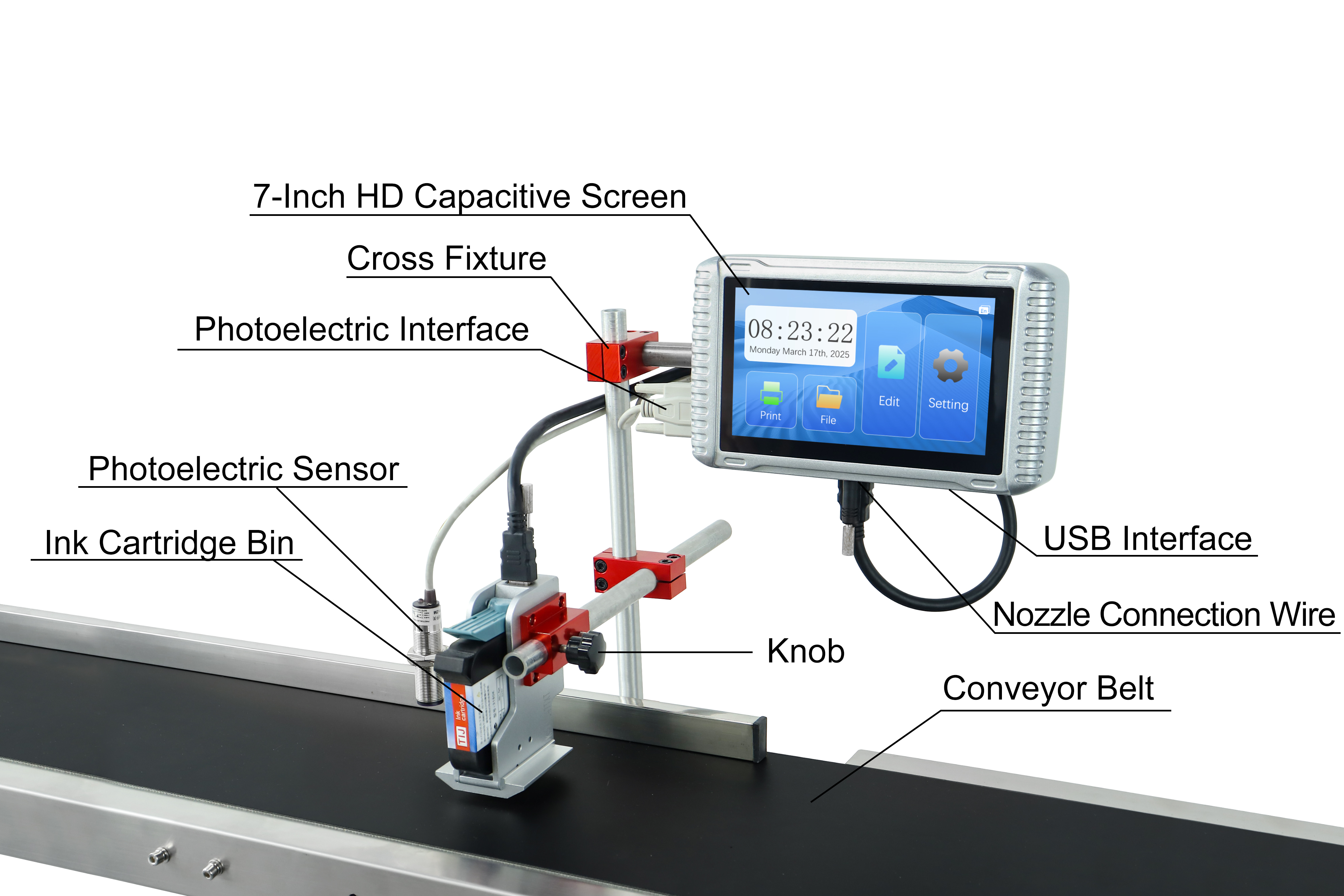
DEMIN L10 online inkjet printer — 120 m/min, 300–600 dpi, 2–12.7 mm print height, cast aluminum alloy body.
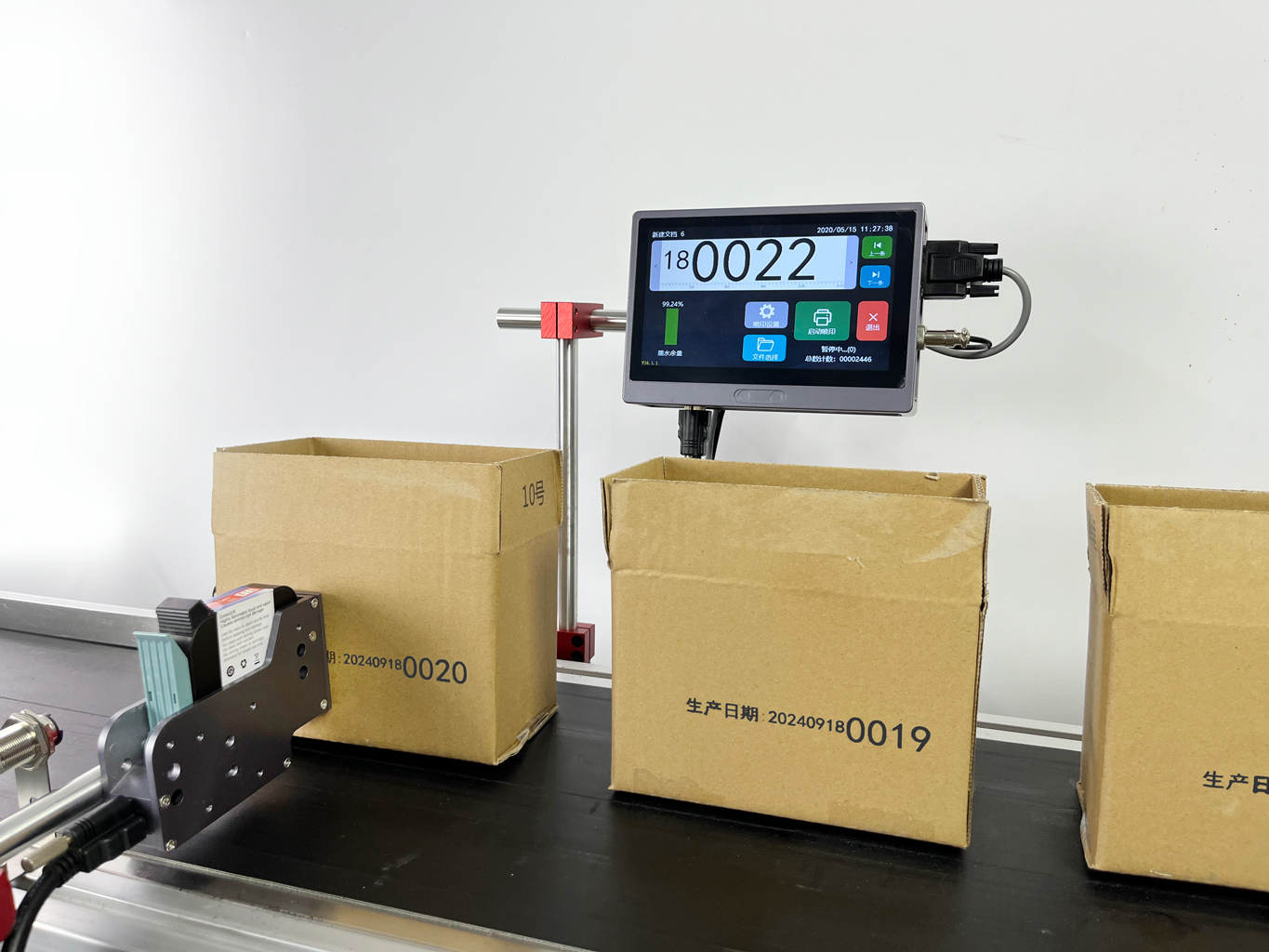
DEMIN S10 online inkjet printer — modular design, self-developed operating system with ink volume calculation function.
Comparison Table: Matching Format to Constraint
The table below restates the constraint decision in a different form. It is not a ranking: each row represents the lowest-cost way to satisfy a specific constraint set within the DEMIN range, based on documented model specifications.
| If your binding constraint is… | Relevant model family | Why |
|---|---|---|
| Line speed above 100 m/min | L10 / S10 | Rated at 120 m/min with 300–600 dpi output |
| Print height above 12.7 mm | P70 / P70 Pro | 5–72 mm print height with 2–15 mm adjustable distance |
| Multi-line or wide-format carton coding | P70 Pro | Seiko 1020 printhead at 360 dpi, 72 mm max height |
| Marking off-conveyor or on irregular product | H50 / M10 | Handheld form, 520–950 g body weight |
| Widest print height on a handheld | H50 | 2–50 mm range at 300 dpi |
| Lightest handheld for single-operator use | M10 | 520 g ABS body, 2–25.4 mm range, 300–600 dpi |
| Network or Ethernet integration | P70 / P70 Pro | RS232 / USB / DB9 / Ethernet (IP) interface set |
| EU market entry on a handheld T-series | T1, T2, T3, T10, T20, T50 | CE Attestation of Conformity AOCXMTN3231012-59588E-02 |
| EU market entry on an in-line S-series | S10, T110, S20, S100, S200 | CE Attestation of Conformity AOCXMTN3231226-78308E-02 |
| US market entry on a handheld M-series | M10 | FCC SDoC 2404Z55407E-EM under FCC Part 15 Subpart B Class B |
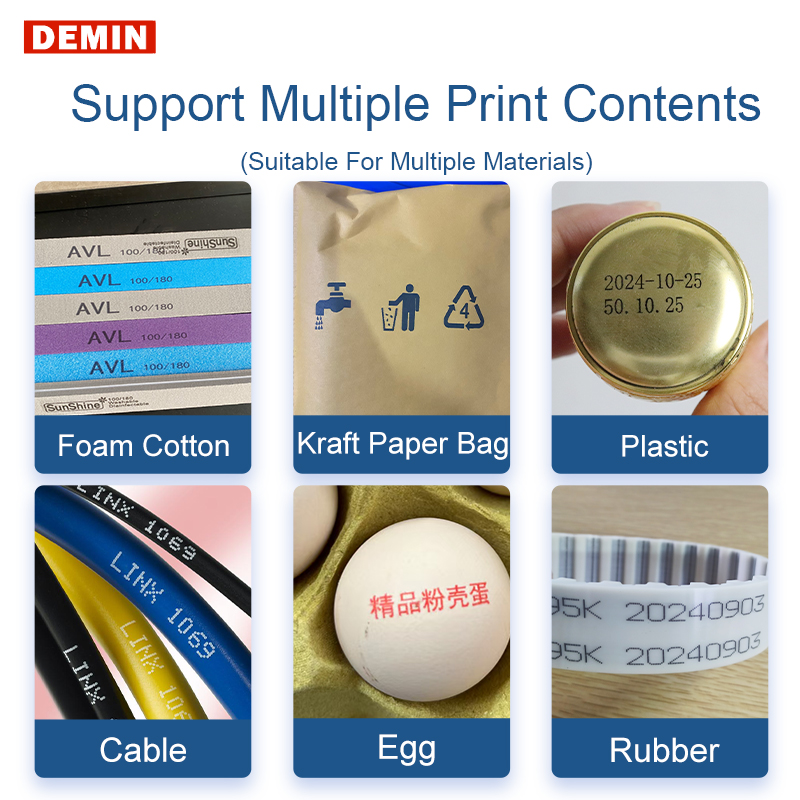
DEMIN M10 handheld inkjet printer — 520 g ABS plastic body, 2–25.4 mm print height, 60 m/min, 300–600 dpi, powered by a 2500 mAh lithium battery at DC 8.4 V.
Environmental Limits and Operating Conditions
Environmental limits are often skipped during evaluation and then become the source of on-site failures. For the P70 and P70 Pro, the rated operating environment is 0–50°C at 10% RH – 90% RH humidity, with a rated voltage of DC 16.8 V at 5 A and a power consumption of 20 W. For the L10 and S10, the rated power parameter is DC 16.8 V at 3 A. The M10 runs on a DC 8.4 V, 2500 mAh lithium battery and provides a 3.5 mm sensor port plus a USB port for external connectivity.
For workshops where ambient temperature climbs — the UAE carton packaging case is one example — the printed specification range should be cross-checked against the actual site readings before installation. If the workshop exceeds 50°C at any point in the shift, the environmental limit becomes the binding constraint rather than the print speed.
Frequently Asked Questions
Which DEMIN industrial inkjet printers carry CE and FCC certification?
Certification is documented per model family. CE attestations of conformity under EMC Directive 2014/30/EU cover: T1, T2, T3, T10, T20 and T50 (AOCXMTN3231012-59588E-02, issued 2023-10-31); the in-line models S10, T110, S20, S100 and S200 (AOCXMTN3231226-78308E-02, issued 2024-02-01); and MX3S, M10, M20 and D10 (AOC RXM211108050-02, issued 2022-01-07). A separate CE record also lists the H50, P70, P70 Pro, L10 and M10 as covered for the EU market. For the US, FCC Supplier's Declarations of Conformity cover T1, T2, T3, T10, T20 and T30 under FCC Part 15 (XMTN3230612-33144E-00, issued 2023-07-25), and D10, M10, MX3, M20 and M100 under FCC Part 15 Subpart B Class B (2404Z55407E-EM, issued 2024-12-03). Buyers should confirm the exact model number against the certificate scope before ordering.
What print speed and resolution can DEMIN industrial inkjet printers achieve?
Performance depends on the platform. The DEMIN L10 and DEMIN S10 online inkjet printers run at 120 m/min with a 300–600 dpi printing resolution, a 2–12.7 mm print height and a 2–5 mm optimal printing distance. The P70 UV piezoelectric printer runs from 1 to 100 m/min at 180 dpi with a Seiko 510 printhead (510 nozzles) and a 5–72 mm print height; the P70 Pro upgrades to a Seiko 1020 printhead at 360 dpi. The H50 and M10 handheld printers both run at 60 m/min, at 300 dpi for the H50 and an adjustable 300–600 dpi for the M10.
What drives consumable consumption and long-term operating cost on these printers?
Three factors dominate. First, ink volume control: the L10 and S10 both include an ink volume calculation function within a self-developed operating system, which is intended to reduce ink consumption per print cycle. Second, ink supply architecture: the P70 and P70 Pro use a negative pressure ink supply system, which is designed for consistent delivery at continuous speeds. Third, ink type and substrate: the P70 series supports water-based, UV and oil-based inks, and the correct ink-substrate match reduces rework and wasted prints. Ink colors available across the range are red, yellow, blue, green, black, white and invisible, with single-color printing. Actual operating cost should be assessed on your own production run rather than from general figures.
Can I validate print quality on my own substrate before placing a production order?
Yes — and you should. DEMIN's printers are described as compatible with carton, plastic, metal, glass, wood and woven fabric surfaces, but adhesion on your specific substrate depends on the ink type, surface finish and curing environment. Handheld models (H50, M10) are the practical route for early sample testing because they can be used directly on the substrate without line installation. OEM orders can start at MOQ 1 unit, which allows a physical unit to be tested in your own facility before any volume commitment. Request a substrate sample print that reflects the actual surface — uncoated corrugated carton behaves differently from coated board or kraft paper.
What are the OEM and ODM lead times, and what warranty applies?
OEM production — logo and startup screen customization — runs at MOQ 1 unit, with a lead time of 30–45 days and a monthly capacity of 8,000 units. ODM production — involving casing drawings, mold opening for injection molding and a fully own-brand machine — runs at MOQ 100 units, with a lead time of 20–35 days and a monthly capacity of 5,000 units. Both modes apply 100% testing. Every DEMIN printer is covered by a one-year warranty, and after-sales support is delivered through online guidance and shipping of replacement parts. To begin, request the DEMIN company brochure or send your substrate and speed requirements directly via the contact details below.
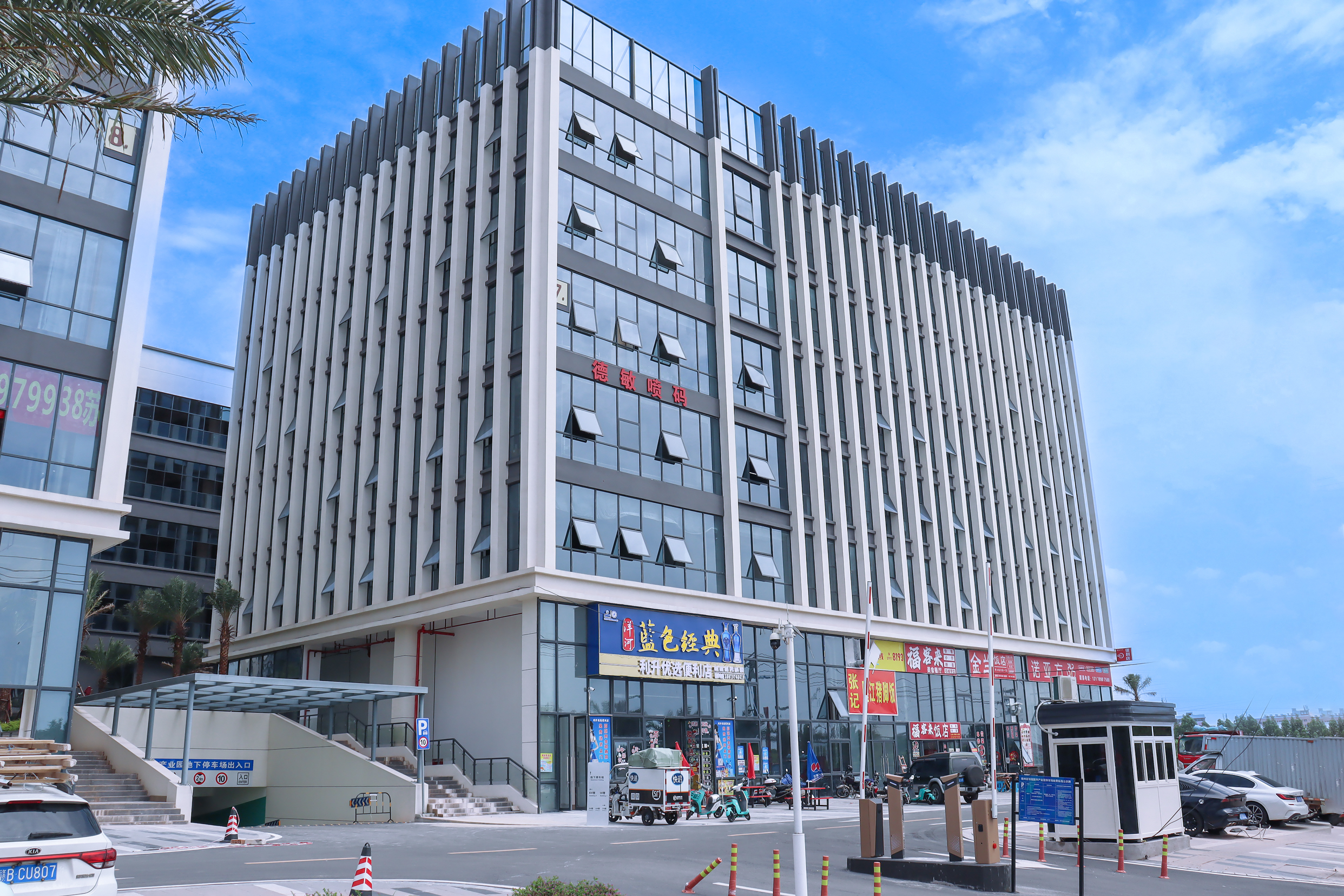
DEMIN factory facility — 3,000 m² manufacturing base with 45-person R&D team and 100% test on OEM and ODM orders.
Conclusion: Certify First, Then Specify
An industrial inkjet printer is a three-constraint decision. Certification determines whether the machine can legally enter the target market. Performance determines whether it can keep up with the line. Substrate compatibility determines whether the print actually holds. Everything else — brand preference, marketing claim, aesthetic finish — is secondary to those three, and no single spec on a datasheet resolves all three at once.
DEMIN's range covers the full constraint map for a Chinese manufacturer of its size: handheld TIJ (H50, M10), online TIJ (L10, S10), and UV piezoelectric (P70, P70 Pro), each with a documented CE and FCC record by model series, plus OEM and ODM programs for distributors. The company operates a 3,000 m² factory with approximately 150 employees, a 45-person R&D team, an annual output of roughly 10,000 units, and an export ratio of around 50%.
Before confirming an order, verify the certificate number against the exact model, test the ink on your own substrate, and confirm the lead time against your production schedule. Those three checks will resolve most of the qualification risk that a specification sheet alone cannot answer.
Request a Sample Print or a Model Quotation
Send us your substrate type, production line speed, print height and target market. DEMIN will match the correct model family, confirm the certificate scope and arrange a pre-production sample for validation.
Contact: Ye | Email: 605004505@qq.com | Tel / WhatsApp: +86 17859391129
Address: Building 7, Digital Industry Park, Economic and Technological Development Zone, Ganzhou City, Jiangxi Province
Official website: www.dminkjet.com. Market context figures are attributed to the listed research sources; product specifications and certification records are manufacturer-documented and should be re-verified against the delivered unit before production qualification.
Have Questions or Need More Details?
Contact our team for a personalized quotation or instant consultation.
Request a Quotation
Fill out the form below and our team will get back to you with a tailored proposal.
WhatsApp Direct Chat
Prefer to chat in real-time? Message us on WhatsApp for instant assistance & quick answers.
- Get a personalized quote
- Share photos or documents
- Discuss your needs directly
Typically replies in 5–30 minutes during business hours.