DEMIN Inkjet Printer: Company Profile for Industrial Buyers
Quanzhou Demin Spraying Code Technology Co., Ltd., which trades as DEMIN Inkjet Printer, is a Chinese coding and marking equipment manufacturer founded in 2017. It builds handheld, online and UV inkjet printers from a 3,000 m² facility staffed by roughly 150 people, including a 45-person R&D team, with an annual production capacity of 10,000 units.
Buyers searching for industrial inkjet printer manufacturers usually start with a page of specifications and a list of supplier names that look interchangeable. This profile approaches the same question from the supplier side: what DEMIN documents about its operations, what its model range is actually built to do, and which parts of a coding project it can support. The purpose is not to rank the company against competitors that were not assessed in this article, but to give buyers a factual starting point for qualification.
Why Sourcing an Inkjet Printer Manufacturer Is Harder Than It Looks
The term “inkjet printer” covers consumer desktop units, continuous inkjet (CIJ) systems, thermal inkjet (TIJ) cartridges, piezoelectric (PIJ) printheads and UV-curable platforms. Manufacturers frequently advertise across several of these categories at once, so two quotations that read similarly on paper can describe machines with entirely different print engines, consumable models and maintenance burdens.
That is the practical difficulty of the discovery stage. A buyer searching for industrial inkjet printer manufacturers is not yet choosing between machines; the buyer is trying to establish which suppliers are genuine manufacturers with production, engineering and after-sales depth, and which are resellers assembling a catalogue.
Supplier qualification can be done with observable facts. Founding year, factory footprint, headcount, R&D headcount, the model list, published specifications, declared certifications, export share, warranty terms and after-sales commitments all describe a supplier without requiring a test bench. None of them proves that a specific printer will perform on a specific line — only a sample print can establish that — but they determine whether a supplier belongs on a shortlist at all.
Industry Background: Where Inkjet Coding Sits in Smart Manufacturing
Published market estimates for inkjet printing vary because their scopes differ. Grand View Research estimated the global inkjet printer market at USD 45.2 billion for 2025 and USD 48.0 billion for 2026, covering industrial, consumer and desktop equipment together (SRC-0001). Global Market Insights, using a narrower industrial definition, valued the industrial inkjet printer segment at USD 5.6 billion in 2025 (SRC-0002). The two figures describe different scopes and should not be averaged or compared directly.
Within the industrial coding market, continuous inkjet (CIJ) technology held a 38.4% revenue share in 2025 according to the Grand View Research dataset (SRC-0001). Food and beverage accounted for 26% of industrial inkjet demand in 2025 on the Global Market Insights estimate (SRC-0002), a share that reflects how closely date coding, batch coding and shelf-life marking are tied to food packaging lines.
Regionally, Smithers projected that Asia Pacific would draw level with North America in global inkjet volume by 2026 and lead by 2031 (SRC-0003). On the standards side, China's press and publication industry standard describes “smart manufacturing of printing” as the deep integration of new-generation information and communication technologies with advanced manufacturing technology across design, production, management and service (SRC-0011, 2022).
For buyers, the implication is practical. Coding equipment is increasingly evaluated as part of a connected production environment rather than as a standalone marking tool. Suppliers with documented engineering teams, defined electrical interfaces and organised quality systems are easier to bring into that environment than suppliers that sell catalogue units only.
DEMIN at a Glance
| Item | Recorded detail |
|---|---|
| Legal name | Quanzhou Demin Spraying Code Technology Co., Ltd. |
| Brand / trading name | DEMIN Inkjet Printer |
| Founded | 2017 |
| Factory area | 3,000 m² |
| Employees | Approximately 150 |
| R&D team | 45 engineers and technicians |
| Annual production capacity | 10,000 units |
| Export ratio | 50% |
| Main markets | Europe, America, Asia — including the United States, Arab, Malaysia, Brazil, Germany, Armenia, Russia, Senegal, Finland and Pakistan |
| Website | www.dminkjet.com |
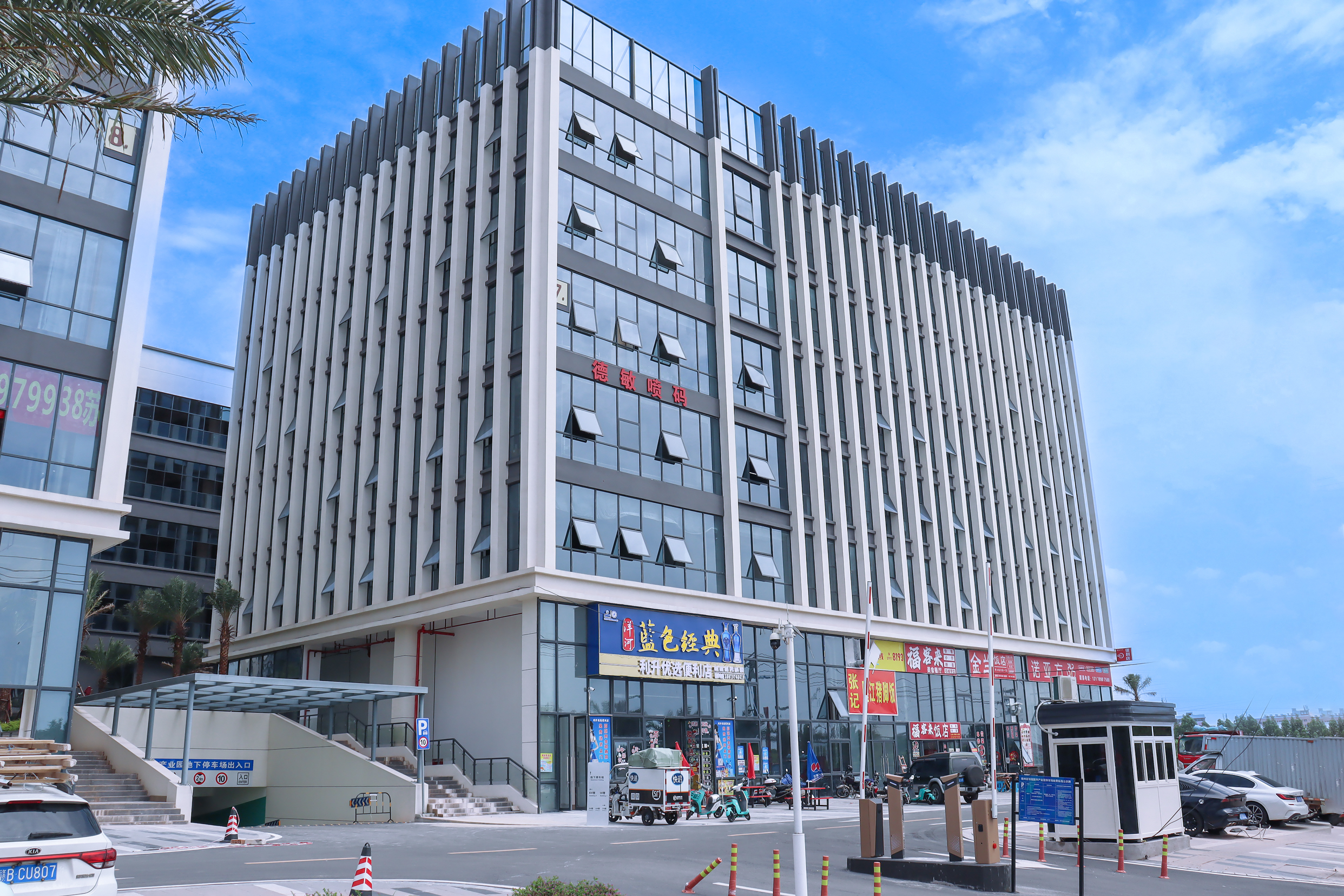
| Address | Building 7, Digital Industry Park, Economic and Technological Development Zone, Ganzhou City, Jiangxi Province |
DEMIN describes itself as an intelligent manufacturing enterprise integrating R&D, precision production, product processing, sales and after-sales service. That description matters at the qualification stage because it frames the company as a producer with an engineering function rather than as a distribution operation. When asked directly whether it is a factory or a trading company, DEMIN states that it is a specialised manufacturer of inkjet printers and related equipment in China, that all products are manufactured in-house, and that it maintains its own R&D team.
Core Products and Solutions
DEMIN's stated product list covers inkjet printers, TIJ inkjet printers, UV inkjet printers, handheld inkjet marking machines, date inkjet printers, product label printers and piezoelectric inkjet printers. Six models are documented with published specifications: four use thermal or general inkjet architectures (two handheld, two online) and two are piezoelectric UV units built around Seiko printheads.
Handheld and portable models: H50 and M10
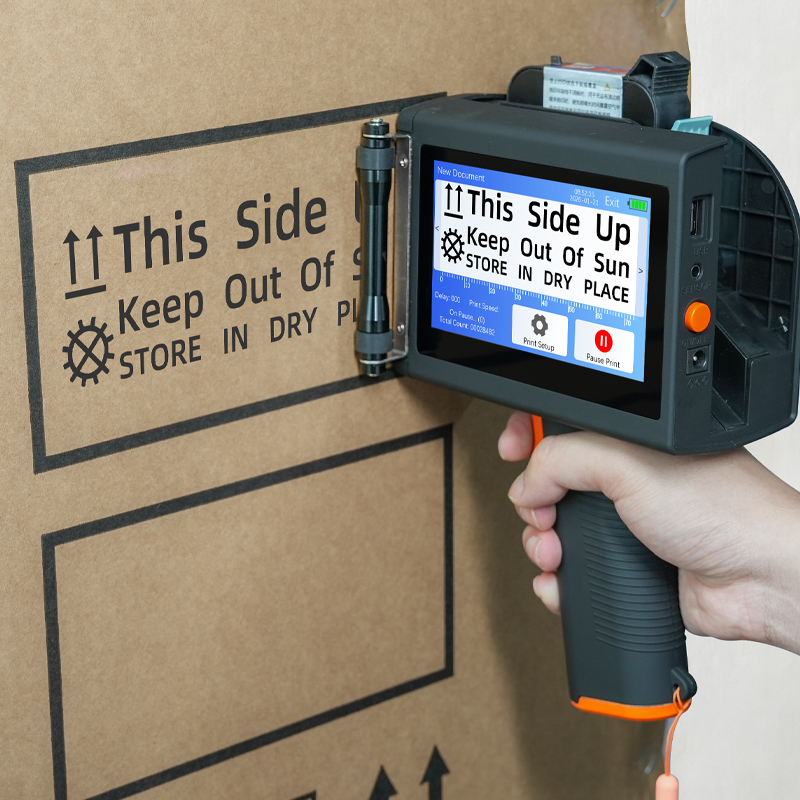
The H50 is a handheld inkjet printer with a 950 g net weight, a 2–50 mm printing size and an optimal printing distance of 2–5 mm. It prints at up to 60 m per minute using ABS and metal construction, a 5-inch capacitive touchscreen and 300 dpi resolution. It is intended for the food industry and the machinery industry.
The M10 is the lighter handheld option at 520 g net weight, aimed specifically at mobile date coding in food packaging. It offers 300–600 dpi resolution, a 2–25.4 mm print height, 60 m per minute printing speed, a 4.3-inch capacitive touchscreen and a DC 8.4V 2500 mAh lithium battery. External interfaces are a 3.5 mm sensor port and a USB port.
Online production line models: L10 and S10
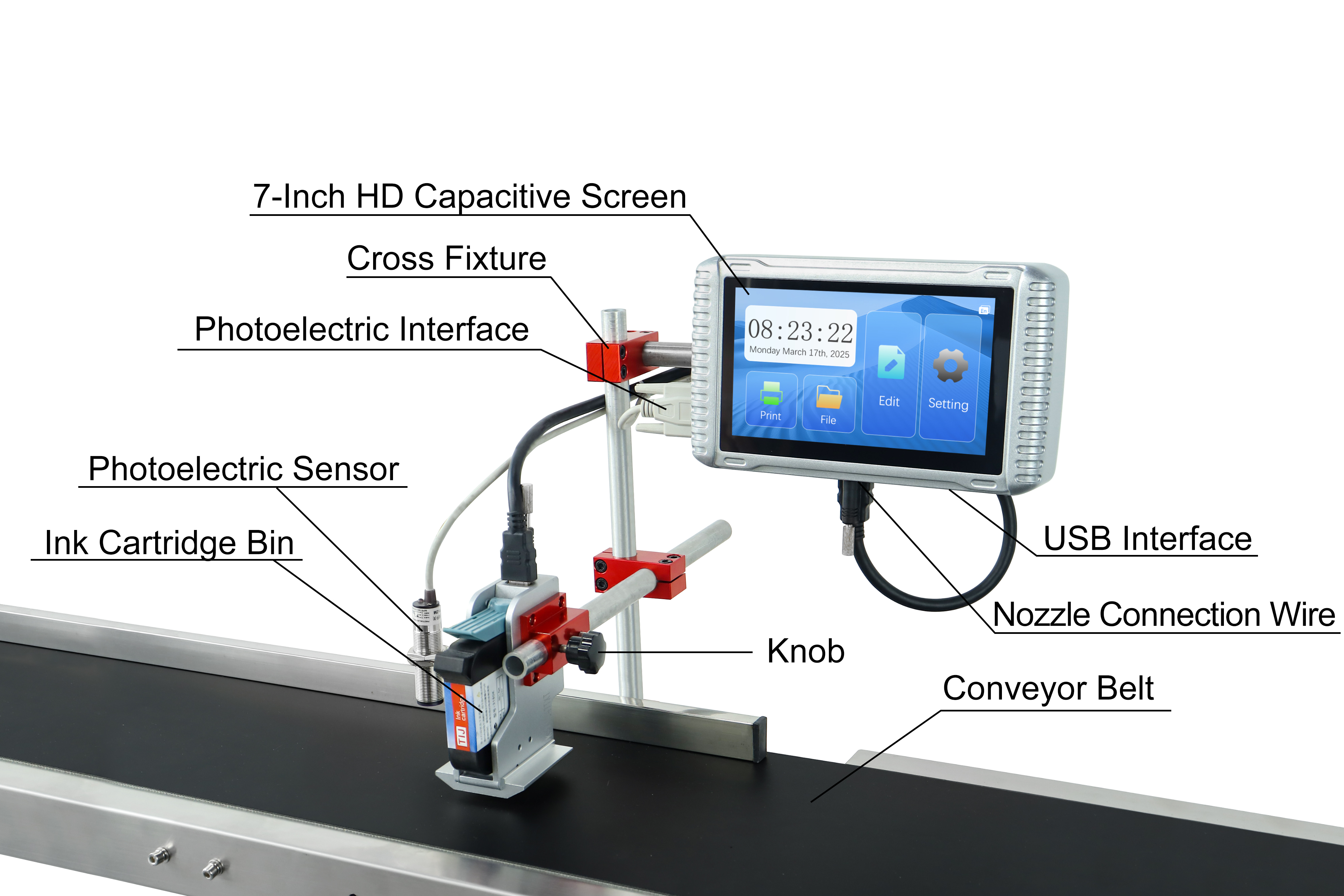
The DEMIN L10 and DEMIN S10 are online inkjet printers designed for production line coding. Both share a 3.5 kg cast aluminium alloy body, 300–600 dpi resolution, 2–12.7 mm print height, 2–5 mm optimal distance and 120 m per minute printing speed. Both use a 7-inch capacitive touchscreen, a DC16.8V 3A power parameter, a DB9 sensor interface and a USB interface, and both are intended for the food industry, packaging manufacturing, production and manufacturing, and the medical industry.
The L10 adds a self-developed operating system, a modular structural design for compatibility with various production line installations, and an ink volume calculation function designed to reduce ink consumption. The S10 is specified for online production line coding scenarios with the same modular compatibility.
UV piezoelectric models: P70 and P70 Pro
The P70 is a piezoelectric UV inkjet printer with a Seiko 510 printhead, 510 nozzles, 180 dpi resolution, a 5–72 mm print height, a 2–15 mm printing distance and a speed range of 1–100 m per minute. It uses aluminium construction, a 10-inch capacitive touchscreen, DC 16.8V 5A rated voltage, 20 W power consumption, a 35 picoliter drop size and a negative pressure ink supply system. It accepts water-based, UV and oil-based inks, operates between 0 °C and 50 °C at 10–90% relative humidity, and exposes RS232, USB, DB9 and Ethernet (IP) interfaces. It is positioned for industrial goods scenarios and online production line marking.
The P70 Pro raises resolution to 360 dpi with a Seiko 1020 printhead while keeping the same 5–72 mm print height, 1–100 m per minute speed range, negative pressure ink supply and interface set. It is intended for the cardboard box manufacturing industry and for packaging code printing and variable data printing. Bulk OEM customisation is available on this model.
Across the range, DEMIN printers support text, dates, batch numbers, serial numbers, QR codes, barcodes and logos. Ink colours listed for the handheld and online models are red, yellow, blue, green, black, white and invisible, and DEMIN states that its machines print on cartons, plastic, metal, glass, wood, woven fabric and other surfaces. Language support runs to 29 languages on the handheld and online models and 30 languages on the P70 and P70 Pro.
Manufacturing, R&D and Quality Control
Production system
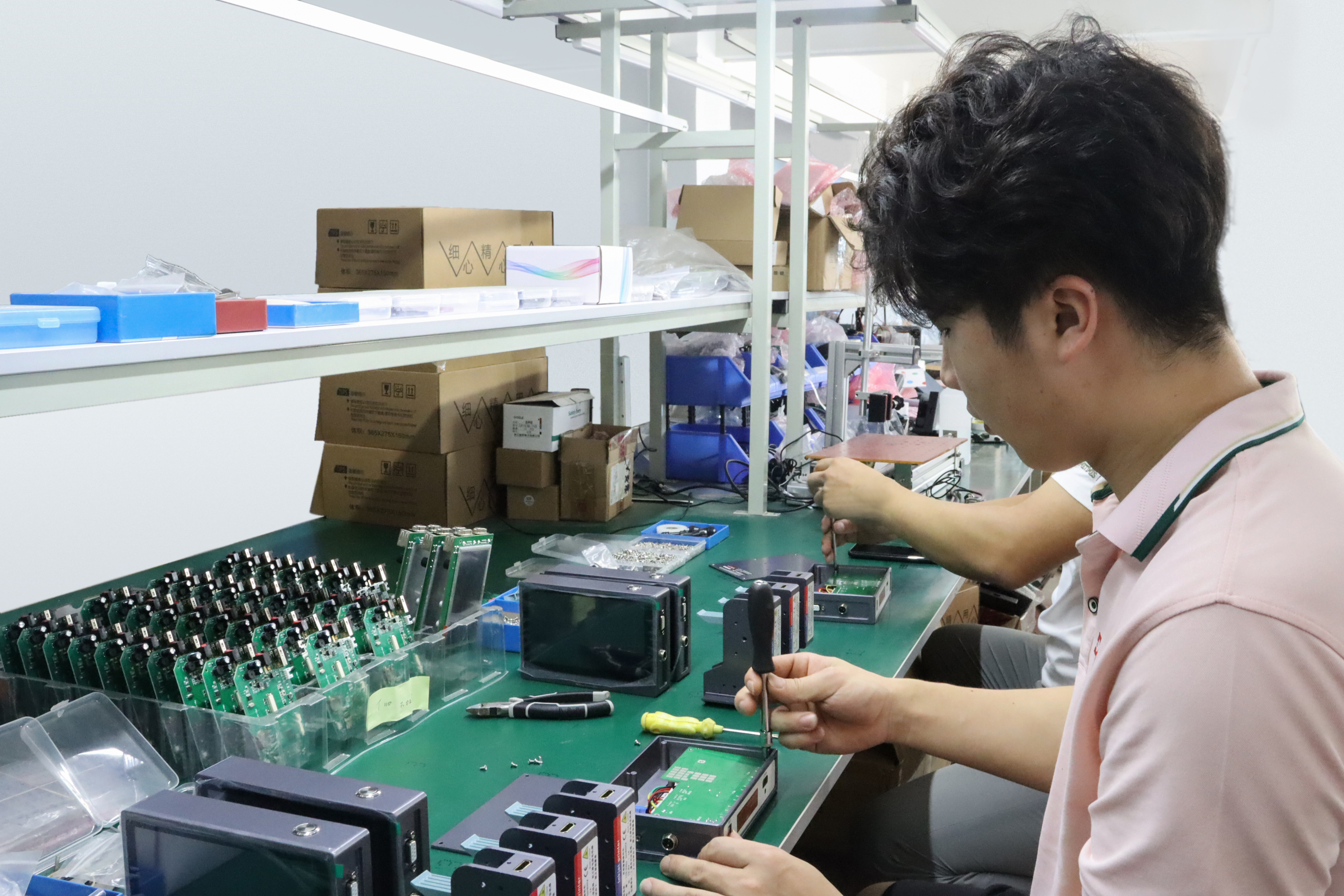
DEMIN operates standardised intelligent workshops with high-precision production and testing equipment and automated production lines. The stated workflow runs from raw material processing through precision manufacturing and performance testing to product assembly as a single connected process. The company describes this as lean and automated manufacturing that replaces rough manual production steps, lowering defect rates and improving consistency across production batches.
R&D capability
A 45-person R&D team supports product optimisation, new model development and process upgrades. DEMIN states that it independently improves product performance and manufacturing techniques, and that its self-developed production processes and intelligent control technologies underpin its technical position. This is consistent with the L10 and S10 self-developed operating system and with the P70 Pro's negative pressure ink supply and 360 dpi Seiko 1020 configuration.
Quality control
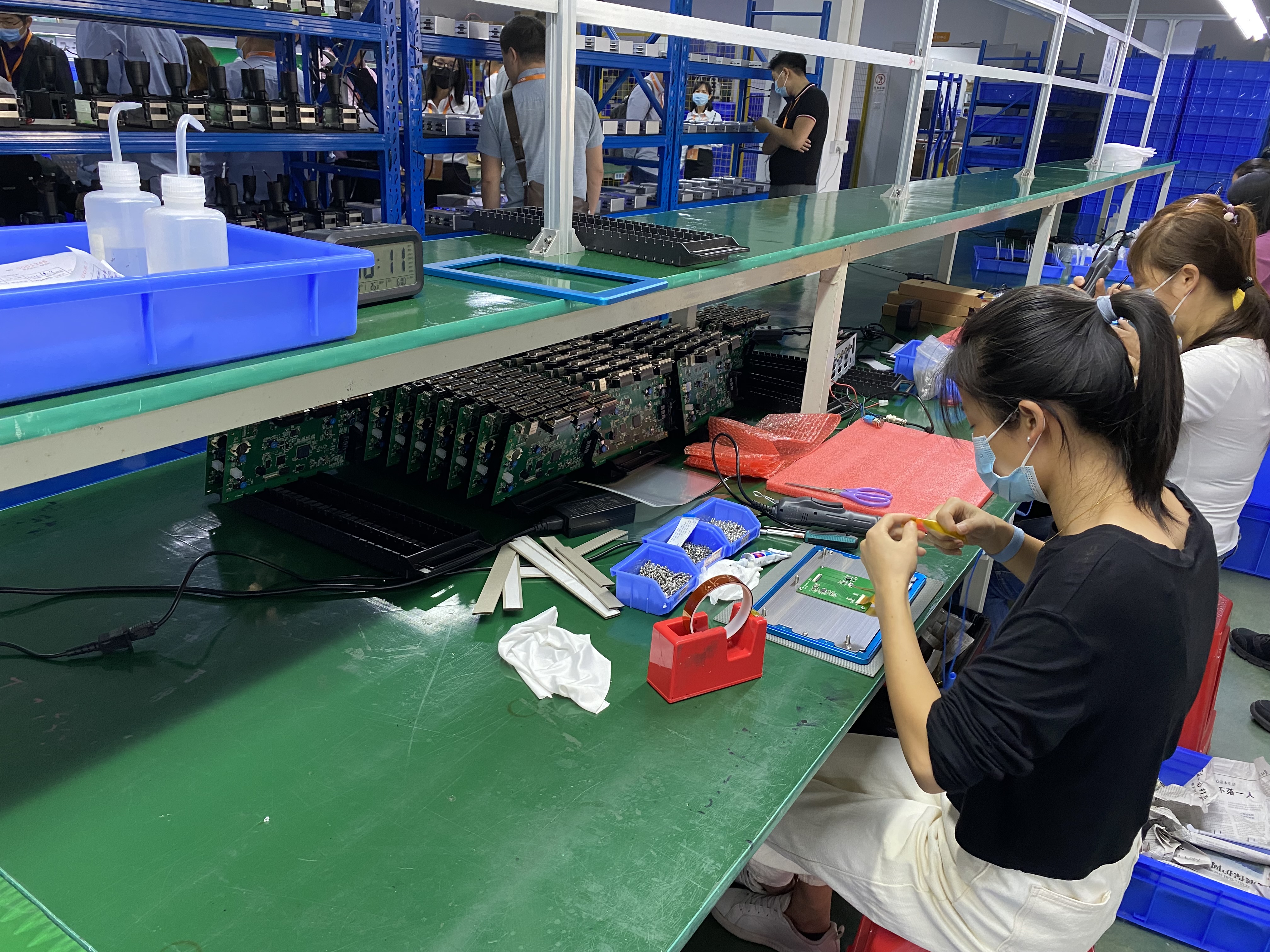
DEMIN follows international and industrial standards with full-process quality management. Raw materials, semi-finished goods and finished products all pass through inspections, and a complete quality traceability system is maintained across production. The company holds ISO 9001 Quality Management System certification, which covers R&D, production and service processes.
Global Supply and Service Model
Half of DEMIN's output is exported, with stated markets across Europe, America and Asia, including the United States, Arab, Malaysia, Brazil, Germany, Armenia, Russia, Senegal, Finland and Pakistan. Language support of 29 to 30 operating languages across the range is directly relevant to that footprint: it determines whether an operator in a target market can use the interface without translation workarounds.
The service model is structured as a full-cycle offering: pre-sales technical consultation, customised solution design, production and delivery, and after-sales support. DEMIN provides a 12-month warranty together with lifelong after-sales service. The company also supports both standard mass production and personalised customisation, which matters for buyers who need a modified configuration rather than a catalogue unit.
Certifications and Industry Recognition
DEMIN's documented qualifications fall into four groups:
- System certification: ISO 9001 Quality Management System certification, described by the company as covering R&D, production and service under internationally standardised management.
- National qualification: National High-Tech Enterprise status, based on continuous R&D input and independent core technologies.
- Intellectual property: multiple independent patents and software copyrights covering self-developed production processes and intelligent control technologies.
- Industry honours: awards including Excellent Industrial Manufacturer and Integrity Demonstration Enterprise.
Step-by-Step: How a Buyer Should Evaluate DEMIN
The qualification facts above establish that DEMIN is a manufacturer with a defined model range and a documented quality system. They do not establish that any specific model will work on a specific line. The following sequence closes that gap.
- Define the coding task precisely. Confirm printing content — production date, expiry date, batch number, serial number, QR code, barcode, logo — plus the number of lines and required character height. DEMIN's own guidance on selecting a coder lists printing content, working environment, printing speed and substrate material as the four inputs that determine the right machine.
- Match the substrate. DEMIN states its printers handle cartons, plastic, metal, glass, wood, woven fabric and other surfaces. Confirm which of these actually matches your packaging and which ink chemistry is proposed for it.
- Choose the machine architecture. Handheld models (H50, M10) suit mobile or distributed marking. Online models (L10, S10) suit conveyor-integrated lines at up to 120 m per minute. UV piezoelectric models (P70, P70 Pro) suit wider print heights up to 72 mm, faster cure and higher resolution on cartons and industrial substrates.
- Confirm production line integration. Check the trigger method, the interface set (DB9 sensor port, USB, RS232, Ethernet), the mounting arrangement and whether the line runs continuously. The documented UAE carton packaging application, for example, uses photoelectric sensor triggering for 24/7 continuous online automatic printing with a conveyor belt, packaging line, photoelectric sensor and UV curing lamp set.
- Run a sample test on the real substrate. Print on the actual carton, film, label or component you will code. Verify legibility, adhesion and drying under your workshop conditions. This step is the only reliable way to confirm fit.
- Lock commercial and service terms. Confirm customisation scope, OEM terms where relevant, warranty coverage, spare parts availability, response time and delivery schedule in writing before ordering.
Application Scenarios
Carton packaging printing on a continuous line
A documented DEMIN deployment in the United Arab Emirates covers carton packaging printing in a manufacturing environment with constant temperature and humidity. The configuration uses photoelectric sensor triggering for 24/7 continuous online automatic printing, matched with a conveyor belt, packaging production line, photoelectric sensor and UV curing lamp set. The stated requirements are stable printing under high-temperature workshop conditions, multi-language font output, and ink with strong adhesion for corrugated carton surfaces.
Food packaging date coding
The M10 handheld inkjet printer is designed for mobile date coding in food packaging and for code printing on multiple material surfaces. Its 520 g weight and 2500 mAh battery make it suitable for marking where a fixed line installation is impractical.
Online production line coding
The DEMIN S10 and DEMIN L10 are specified for food, packaging manufacturing, production and manufacturing, and medical industry applications at up to 120 m per minute, with modular design for compatibility with various production line installations.
Cardboard box and variable data printing
The P70 Pro is positioned for the cardboard box manufacturing industry, covering packaging code printing and variable data printing. Its 5–72 mm print height and 360 dpi Seiko 1020 head suit larger characters and denser codes than the handheld and online models.
Industrial goods marking
The P70 UV inkjet printer is designed for industrial goods scenarios and online production line marking, with water-based, UV and oil-based ink options for different substrate and durability requirements.
Model Comparison
| Model | Type | Print height | Resolution | Print speed | Screen | Net weight |
|---|---|---|---|---|---|---|
| H50 | Handheld inkjet printer | 2–50 mm | 300 dpi | 60 m/min | 5-inch capacitive | 950 g |
| M10 | Handheld inkjet printer | 2–25.4 mm | 300–600 dpi | 60 m/min | 4.3-inch capacitive | 520 g |
| DEMIN L10 | Online inkjet printer | 2–12.7 mm | 300–600 dpi | 120 m/min | 7-inch capacitive | 3.5 kg |
| DEMIN S10 | Online inkjet printer | 2–12.7 mm | 300–600 dpi | 120 m/min | 7-inch capacitive | 3.5 kg |
| P70 | UV inkjet printer | 5–72 mm | 180 dpi | 1–100 m/min | 10-inch capacitive | Not stated |
| P70 Pro | UV inkjet printer | 5–72 mm | 360 dpi | 1–100 m/min | 10-inch capacitive | Not stated |
Where the handheld and online models differ most in practice is integration. The handheld units trade speed and resolution for portability and battery operation. The online units add conveyor compatibility, sensor triggering and modular installation at double the handheld line speed. The UV models step up to a 5–72 mm print height, Ethernet connectivity and selectable water-based, UV and oil-based inks.
Frequently Asked Questions
Is DEMIN an inkjet printer manufacturer or a trading company?
DEMIN states that it is a specialised manufacturer of inkjet printers and other related equipment in China, that all products are manufactured in-house, and that it maintains its own R&D team to support customers. The company is registered as Quanzhou Demin Spraying Code Technology Co., Ltd. and was founded in 2017.
Which inkjet printer types and models does DEMIN produce?
The documented range includes handheld inkjet printers (H50 and M10), online inkjet printers (DEMIN L10 and DEMIN S10), and UV piezoelectric inkjet printers (P70 and P70 Pro). The broader product list also covers TIJ inkjet printers, handheld inkjet marking machines, date inkjet printers, product label printers and piezoelectric inkjet printers.
Does DEMIN offer OEM or customised configurations?
DEMIN supports both standard mass production and personalised customisation. Bulk OEM customisation is specifically stated as available on the P70 Pro UV inkjet printer. Customisation scope should be confirmed in writing for each order.
What materials can DEMIN inkjet printers print on?
DEMIN states that its printers can mark cartons, plastic, metal, glass, wood, woven fabric and other surfaces. Because adhesion and durability depend on the specific substrate and ink, a sample print on the actual material should be completed before procurement approval.
What warranty and after-sales support does DEMIN provide?
DEMIN provides a 12-month warranty together with lifelong after-sales service. Buyers can review the full product and company details in the English brochure before requesting a sample or a quotation.
Conclusion: Where DEMIN Fits in a Buyer Shortlist
DEMIN Inkjet Printer is a 2017-founded manufacturer with a 3,000 m² facility, approximately 150 staff, a 45-person R&D team and an annual capacity of 10,000 units. Its product range spans handheld, online and UV piezoelectric coding, with published specifications across six models, ISO 9001 certification and a 12-month warranty with lifelong after-sales service. Half of its output is exported across Europe, America and Asia.
That profile suits a specific kind of buyer: one that needs coding across more than one scenario — some mobile date coding, some conveyor-integrated line marking, some wider-format carton printing — and wants a single supplier that can configure across those needs, supports customisation and OEM terms, and offers defined warranty coverage. Buyers with a single narrow, high-volume line requirement will still need sample testing and a total-cost comparison before committing.
The wider direction of the category supports the positioning. The smart manufacturing of printing definition emphasises connected design, production, management and service processes (SRC-0011), and Asia Pacific is projected to draw level with North America in global inkjet volume by 2026 (SRC-0003). Coding equipment that offers Ethernet connectivity, remote-capable interfaces and documented language support is better placed for that direction than equipment sold on print speed alone.
Next Step: Sample Testing and Quotation
Send your substrate type, printing content and line speed to DEMIN to request a sample print and a configuration quotation for the H50, M10, DEMIN L10, DEMIN S10, P70 or P70 Pro.
Email: 605004505@qq.com | Tel / WhatsApp: +86 17859391129
Request a Quote on WhatsAppDownload the English Brochure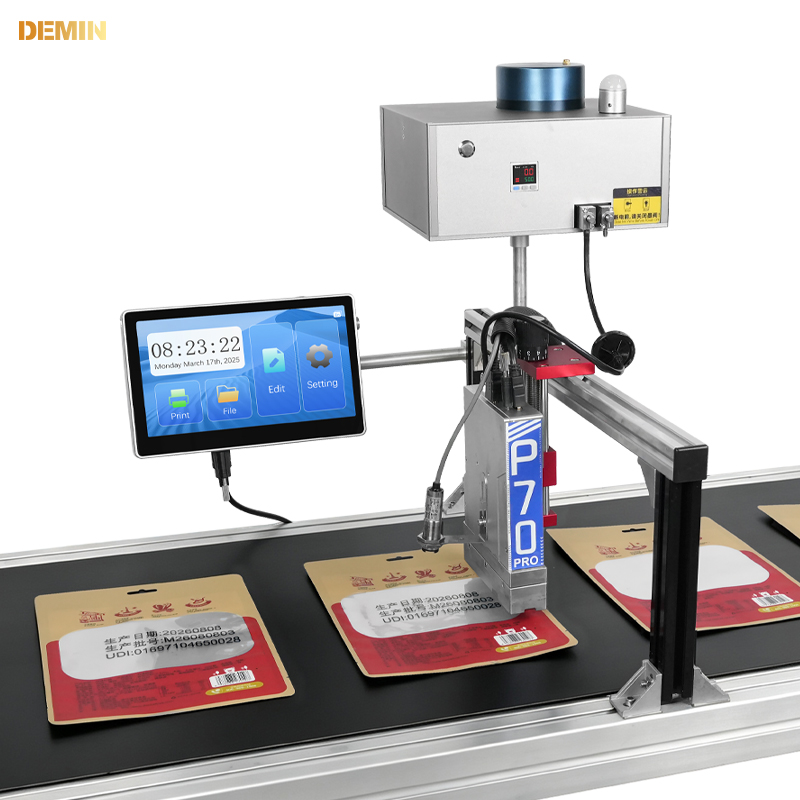
Have Questions or Need More Details?
Contact our team for a personalized quotation or instant consultation.
Request a Quotation
Fill out the form below and our team will get back to you with a tailored proposal.
WhatsApp Direct Chat
Prefer to chat in real-time? Message us on WhatsApp for instant assistance & quick answers.
- Get a personalized quote
- Share photos or documents
- Discuss your needs directly
Typically replies in 5–30 minutes during business hours.