Five Inkjet Printer Models Ranked for Smart Manufacturing Production Lines
Five picks, one ranking logic. This page ranks the DEMIN Inkjet Printer range — P70 Pro, P70, S10, L10, H50 and M10 — by how well each model fits a running production line, using four stated criteria: stable continuous printing, easy maintenance, long service life and responsive technical support. The online piezoelectric models take the top two places; the handheld units close the list because they solve a different line problem.
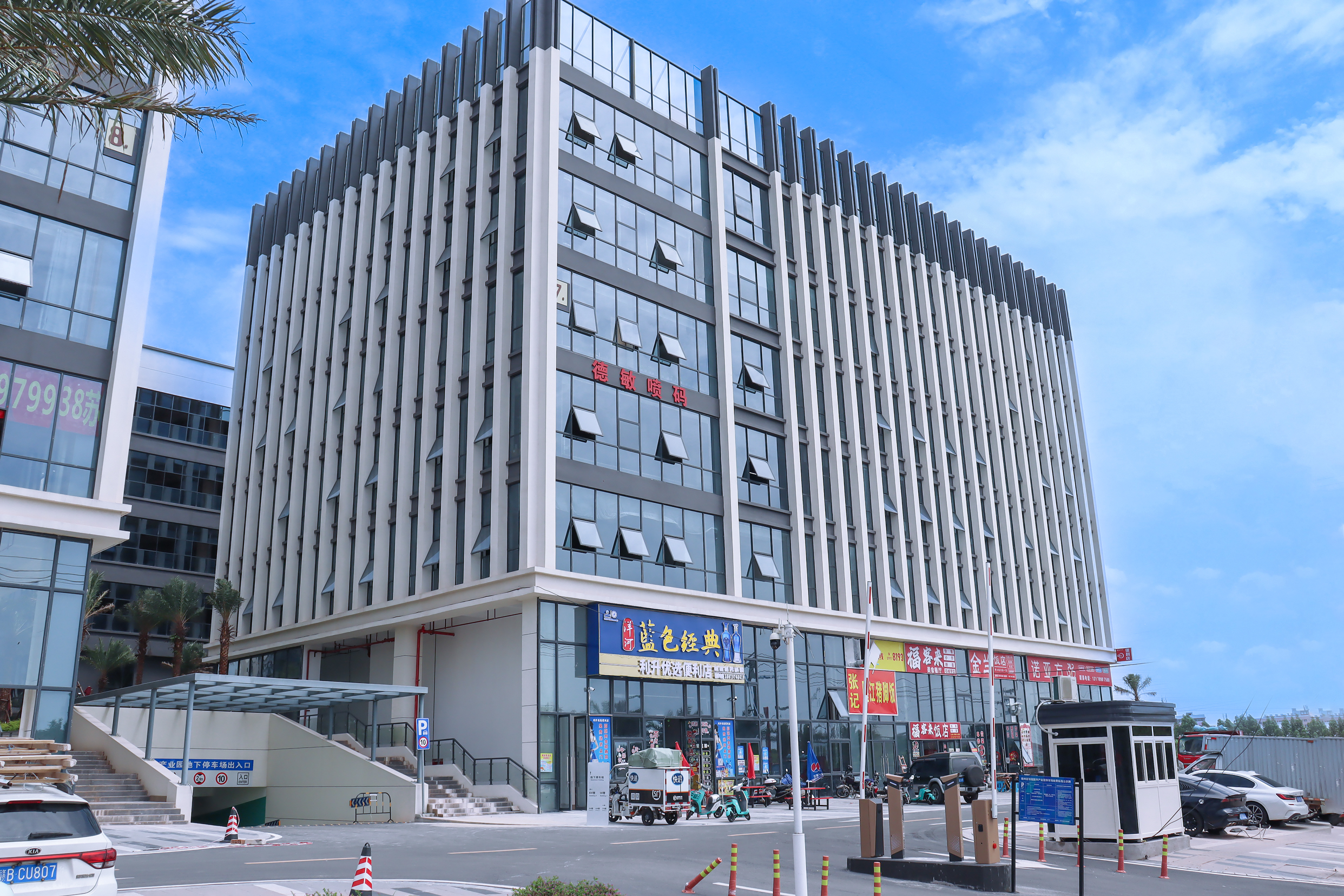
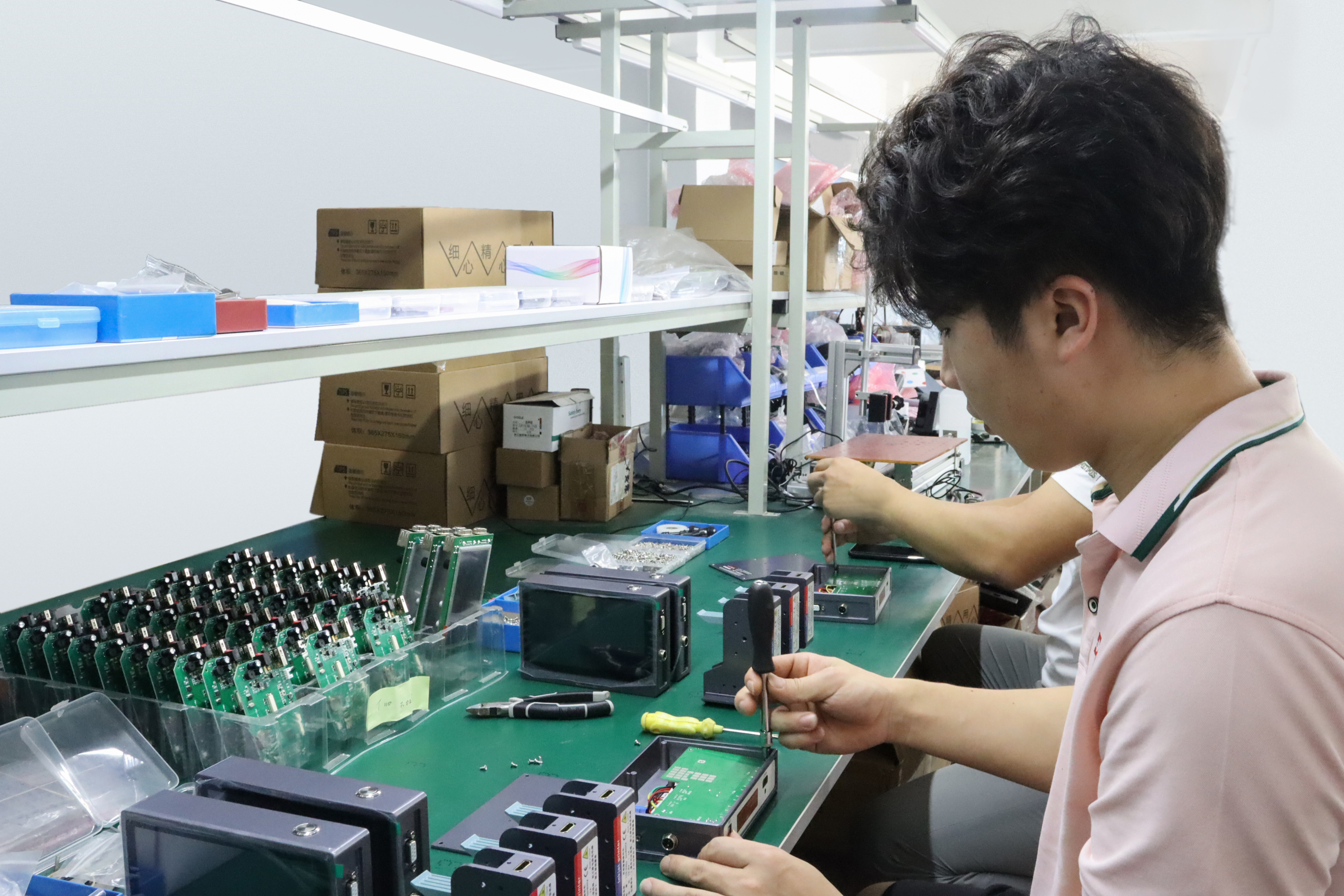
DEMIN Inkjet Printer is the industrial coding brand of Quanzhou Demin Spraying Code Technology Co., Ltd., a Chinese manufacturer founded in 2017. The company operates a 3,000 m² facility with 150 employees, a 45-person research and development team and an annual output of 10,000 units, and builds thermal inkjet (TIJ) handheld and online coders as well as piezoelectric (PIJ) and UV coding systems for packaging, food and industrial lines.
Direct answer — the ranking at a glance:
- P70 Pro — 360 dpi piezoelectric head, 5–72 mm print height, 1–100 m/min, three ink chemistries, Ethernet/RS232/USB/DB9 interfaces.
- P70 — same 1–100 m/min platform and 5–72 mm height at 180 dpi with a Seiko 510 head.
- S10 and L10 — the in-line pair: 120 m/min, 300–600 dpi, 2–12.7 mm height, cast aluminium alloy body.
- H50 — handheld, 60 m/min, 2–50 mm printing size for large-character field marking.
- M10 — 520 g handheld, 60 m/min, 300–600 dpi, cartridge-based with power-off cartridge installation.
1. Problem Definition: Why Line-Ready Model Selection Fails
Most inkjet printer mistakes on a production line are not printing-quality mistakes. They are fit mistakes made before the purchase order, and they show up later as rework, missed maintenance windows or a code head that cannot keep up with the conveyor.
Four failure patterns account for most of them:
- Speed mismatch. The published speed ranges in this range differ by a factor of two — 1–100 m/min on the P70 platform, 120 m/min on the S10 and L10, 60 m/min on the handhelds. A unit specified below line speed either limits throughput or forces a second pass.
- Print-height and content mismatch. A 2–12.7 mm window carries a date code and a short batch number comfortably; it does not carry a five-line ingredient block or a logo. The P70/P70 Pro platform reaches 5–72 mm and the H50 reaches 2–50 mm for that reason.
- Ink and substrate mismatch. The same printer behaves differently on coated carton, kraft paper, plastic film, metal and glass. Ink chemistry — water-based, UV or oil-based — has to be chosen with the substrate, not after it.
- Support gap. A coding unit that stops at 02:00 needs a part number, a technician and an answer, not a marketplace listing.
This page therefore ranks models on line duty rather than on feature count, and it states the limit of each pick instead of presenting all five as universal.
2. Industry Background: Coding Equipment Inside Smart Manufacturing
Coding and marking equipment has moved from an accessory to an equipment-layer asset. China's National Press and Publication Administration industry standard, published in 2022, defines printing smart manufacturing as the deep integration of new-generation information and communication technology with advanced manufacturing technology across the design, production, management and service stages of printed products. Academic descriptions of Industrial IoT architecture place industrial printers and coders in the equipment layer alongside robots and sensors — equipment that has to be triggered, monitored and connected rather than operated in isolation.
Market context supports the same direction:
- Global Market Insights values the industrial inkjet printer segment at USD 5.6 billion in 2025 and attributes 26% of that revenue to the food and beverage vertical.
- Grand View Research reports the total inkjet printer market — consumer and industrial combined — at USD 45.2 billion in 2025 and USD 48.0 billion in 2026. This measures a different scope from the industrial figure above; the two should not be added or averaged.
- Smithers expects Asia Pacific to draw level with North America in global inkjet volume by 2026.
For a buyer, the practical translation is narrow: line integration, variable data and traceability now drive model choice as much as print quality does. That is why interface availability — RS232, USB, DB9 sensor input and Ethernet IP on the P70 platform — is treated as a ranking input on this page rather than a footnote.
3. How the Five Picks Were Ranked
The ranking uses four criteria stated in the model-selection guidance DEMIN publishes for industrial coders. Each criterion is tied to something a buyer can check in a specification sheet or a factory visit.
| Criterion | What was checked | Why it changes the rank |
|---|---|---|
| Stable continuous printing | Published speed range, printhead family, ink supply system, print distance, sensor-triggered operation | Continuous duty exposes speed and ink-feed weaknesses that short runs hide |
| Easy maintenance | Cartridge access and removal procedure, printhead serviceability, screen size, interface layout | Maintenance time is unplanned downtime on a running line |
| Long service life | Body material, printhead platform, ink supply design, operating environment range | Housing and head construction set the practical service envelope |
| Responsive technical support | Warranty terms, after-sales scope, in-house R&D capacity, spare-part path | A trader can sell the box; only a manufacturer can support it over years |
Two transparency notes. First, this is a specification-based ranking of DEMIN's own range, not a measured field benchmark against third-party brands. Second, every DEMIN model carries a 12-month warranty and lifelong after-sales service, so support separates DEMIN from trading-company suppliers as a group rather than separating one DEMIN model from another.
4. The Five Picks, Ranked
P70 Pro — the flagship for dense variable data on cartons and boards
Inclusion reason: the P70 Pro is the only model in the range that combines a 360 dpi piezoelectric printhead with a 5–72 mm print height and a 1–100 m/min speed band, which is the combination a packaging line needs when a single pass must carry a date, a batch number, a serial number, a QR code and a logo block.
- Type: Piezoelectric inkjet printer
- Printing speed: 1–100 m/min
- Resolution: 360 dpi
- Print height: 5–72 mm
- Printing distance: 2–15 mm
- Printhead: Seiko 1020
- Ink types: Water-based, UV, oil-based
- Ink supply: Negative pressure system
- Screen: 10-inch capacitive touch screen
- Interfaces: RS232, USB, DB9, Ethernet (IP)
- Power: DC 16.8V 5A, 20 W
- Environment: 0–50 °C, 10%–90% RH
- Body material: Stainless steel
- Languages: 30 operating languages
Line role: primary in-line coder on carton, board, pipe, cable, metal and plastic substrates. The Ethernet (IP) port and DB9 sensor input are the two features that matter during integration, because they let the coder be triggered by the line rather than operated by hand. Limit: 360 dpi is the top of this range, but it remains a single-pass coding resolution — it is not a graphics-printing specification.
P70 — the same platform at 180 dpi where large-character codes are enough
Inclusion reason: the P70 keeps the 1–100 m/min speed band, the 5–72 mm print height, the three ink chemistries and the full interface set, and lowers resolution to 180 dpi with a Seiko 510 printhead. For a line printing large date and batch codes on corrugated carton, that is the more proportionate configuration of the same platform.
- Type: Piezoelectric inkjet printer
- Printing speed: 1–100 m/min
- Resolution: 180 dpi
- Print height: 5–72 mm
- Printhead: Seiko 510
- Nozzles: 510
- Ink types: Water-based, UV, oil-based
- Interfaces: RS232, USB, DB9, Ethernet (IP)
- Body material: Aluminium
- Languages: 30 operating languages
Line role: high-speed date, batch and lot coding on secondary packaging, where the code is read by a human or a wide-field scanner rather than a dense-data reader. Limit: at 180 dpi the head is not the right choice when the same pass has to produce a small QR code alongside the date.
S10 and L10 — the in-line pair for the fastest specified speed
Inclusion reason: these two online models carry the highest specified printing speed in the range at 120 m/min and are built around a cast aluminium alloy body, a 7-inch capacitive touch screen and a DB9 sensor interface — the configuration of a unit designed to sit permanently on a conveyor and fire on sensor trigger. Their published specifications are identical, so they are ranked as one pick occupying one line role.
- Type: Online inkjet printer
- Printing speed: 120 m/min
- Resolution: 300–600 dpi
- Print height: 2–12.7 mm
- Optimal printing distance: 2–5 mm
- Weight: 3.5 kg
- Body material: Cast aluminium alloy
- Screen: 7-inch capacitive touch screen
- Power: DC 16.8V 3A
- Interfaces: DB9 sensor interface, USB
- Ink colours: Red, yellow, blue, green, black, white, invisible
Line role: date coding, batch coding and short variable data on packaging film, labels, sachets and carton faces where the printable band is narrow but the line is fast. Limit: the 2–12.7 mm height window rules out multi-line ingredient lists and large logos; that work belongs to the P70 platform or the H50.
H50 — large-character handheld marking where the line cannot stop
Inclusion reason: the H50 covers a 2–50 mm printing size at 60 m/min in a 950 g handheld body made of ABS and metal. That combination exists for one job: marking assembled, bulky or already-wrapped goods on the line, at a character height no 12.7 mm in-line head can produce.
- Type: Handheld inkjet printer
- Printing size: 2–50 mm
- Printing speed: 60 m/min
- Optimal printing distance: 2–5 mm
- Weight: 950 g
- Body material: ABS + metal
- Documented industries: Food, machinery
Line role: large date and lot codes on cartons, drums and palletised goods, plus re-marking after repacking. Limit: 60 m/min is a manual pass speed matched to the operator's stroke, not a substitute for a 120 m/min in-line head on a high-speed conveyor.
M10 — the cartridge-based field unit with power-off installation
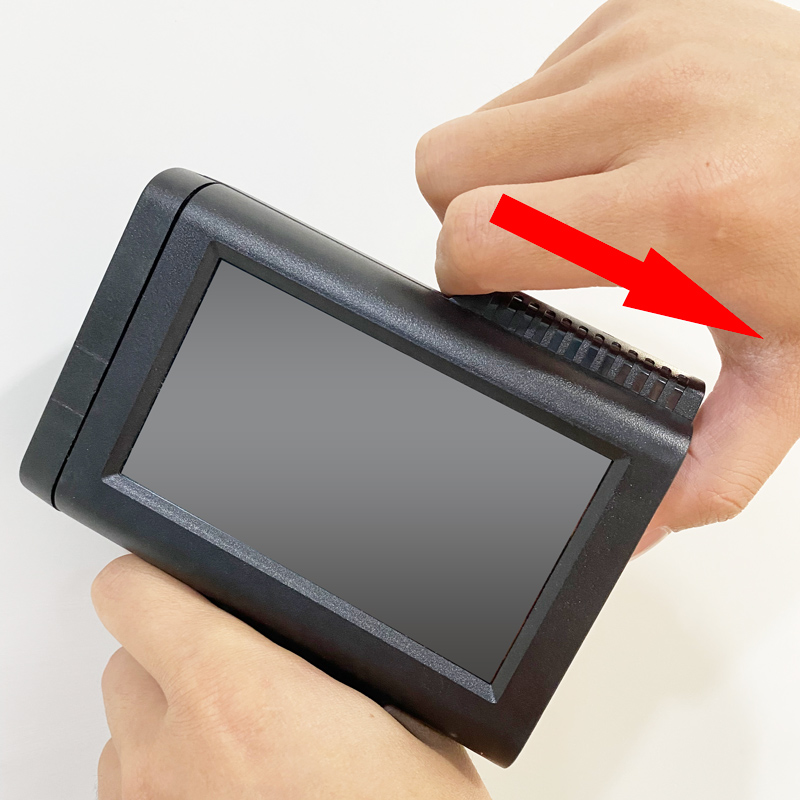
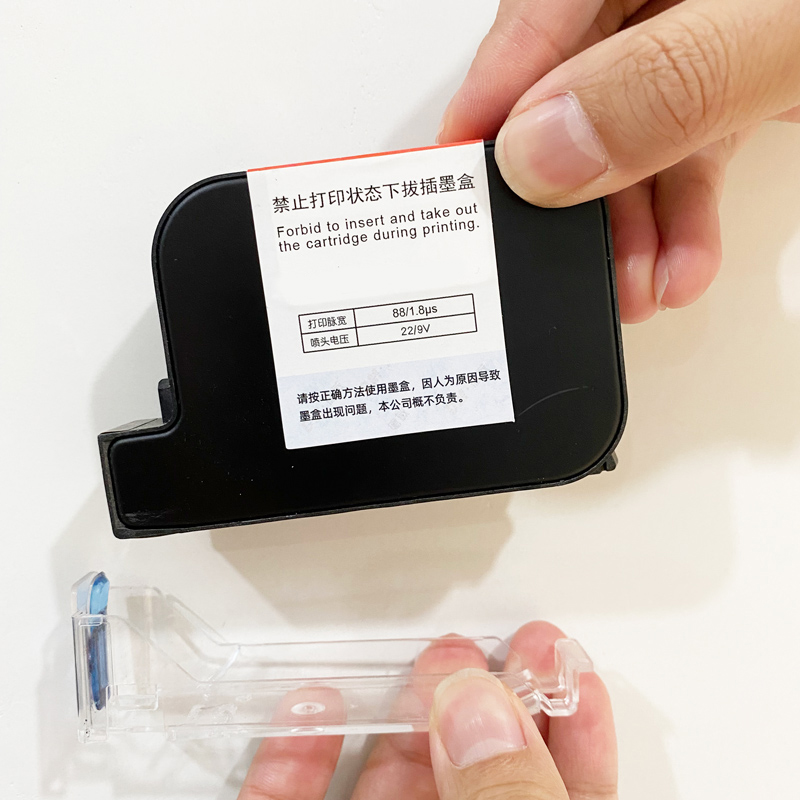
Inclusion reason: at 520 g the M10 is the lightest unit in the range, and it is the model whose maintenance procedure is explicitly documented: the power must be switched off before the cartridge is touched, the cartridge goes in at a 45-degree angle, and the lever is pushed up until it sits flush with the machine body. Cartridges must not be removed while the device is powered on. That procedure is the reason the M10 ranks as a maintenance-first field tool rather than a line head.
- Type: Handheld inkjet printer
- Print height: 2–25.4 mm
- Resolution: 300–600 dpi
- Printing speed: 60 m/min
- Optimal printing distance: 2–5 mm
- Weight: 520 g
- Body material: ABS plastic
- Screen: 4.3-inch capacitive touch screen
- Power: DC 8.4V, 2500 mAh lithium battery
- Interfaces: 3.5 mm sensor port, USB
- Ink colours: Red, yellow, blue, green, black, white, invisible
- Languages: 29+
Line role: field marking, incoming-goods labelling and short runs where a fixed head is impractical. The 3.5 mm sensor port allows semi-automatic triggering on a simple fixture. Limit: 2–25.4 mm print height and battery power make it a supplementary tool on a line, not the primary conveyor coder.
5. Step-by-Step: Applying the Ranking to Your Line
- Fix the print content first. List every element that must appear in one pass — date, expiry, batch, serial number, QR or barcode, logo, ingredient text. The tallest block sets the minimum print height and eliminates models before anything else is discussed.
- Read your actual line speed. If the conveyor runs above 100 m/min, the P70 platform is out of range and the S10/L10 pair at 120 m/min becomes the candidate. Below 100 m/min, the P70 or P70 Pro usually wins on height and resolution.
- Match ink chemistry to substrate. Confirm whether the surface is carton, kraft paper, plastic, metal, glass, wood or woven fabric, then select water-based, UV or oil-based ink accordingly. Sample-print on the real substrate before committing — model-level adhesion on your specific material is a test result, not a datasheet line.
- Check the maintenance path. For a fixed head, confirm how the printhead is accessed and how long the line must stop. For a handheld, confirm the cartridge change procedure; on the M10 it is a power-off operation by design.
- Confirm interfaces against your control scheme. A photoelectric-sensor trigger, an RS232 link to a PLC or an Ethernet connection to a line network each require a specific port. Verify the port exists on the chosen model before ordering, not after installation.
- Validate support and delivery. DEMIN builds in-house with a 45-person R&D team, runs 100% testing on finished units, holds ISO 9001 certification and a National High-Tech Enterprise qualification, and quotes a standard delivery time of 30–45 days from a monthly capacity of 8,000 units. Minimum order quantity is 1 unit for OEM production, where logo and startup-screen customisation are available; ODM housing development starts at 100 units.
6. Use Cases Behind the Ranking
Case: 10 units, five years, food factory outer packaging
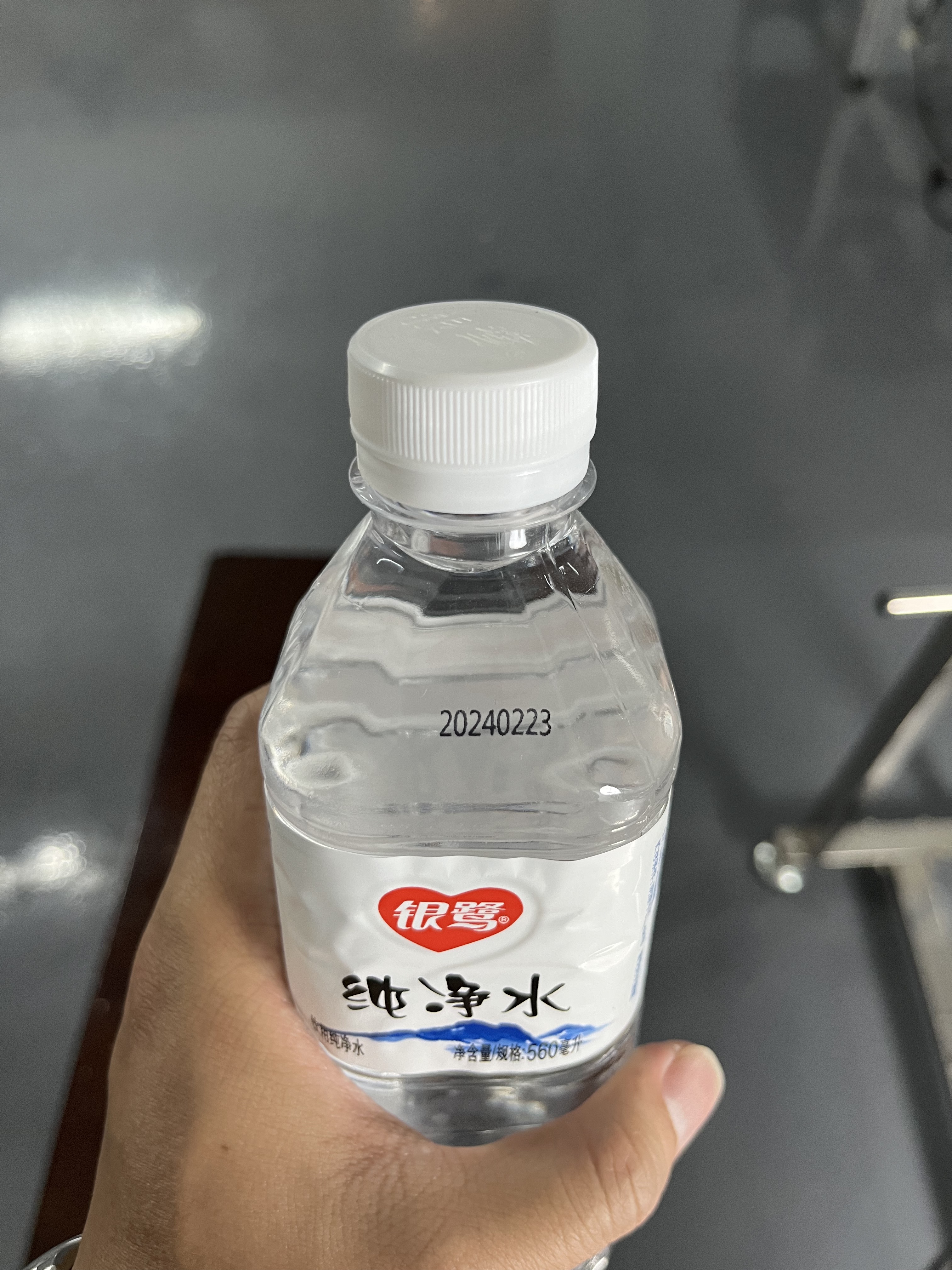
An Argentina-based food factory deployed 10 inkjet printer units for printing the production date on the outer packaging of its products and has run them for five years of service. The reported outcome is fault-free long-term operation, clear prints, simple operation and good after-sales service, and the notable achievements cited are a simple machine structure and fast operation setup for packaging date printing. That is the profile the handheld and compact online picks on this page are designed for: repeated short codes at moderate speed, with setup time shorter than the production changeover.
Scenario: sensor-triggered 24/7 carton coding
A documented manufacturing application in the United Arab Emirates uses a conveyor belt, packaging production line, photoelectric sensor and UV curing lamp set to print labels on product packaging, triggered by the photoelectric sensor for continuous online automatic printing around the clock. The stated requirements are stable printing in a high-temperature workshop, multi-language font output and ink with strong adhesion on corrugated carton surfaces. That combination — UV-curable ink, sensor trigger, Ethernet or DB9 integration and 5–72 mm height — maps to the P70 Pro at the top of this ranking.
7. Comparison Table: All Six Models on the Same Criteria
All values below are published DEMIN specifications. Where two models share an identical specification, they are grouped rather than separated by invented differences.
| Rank | Model | Type | Print speed | Resolution | Print height / size | Ink options | Inclusion reason |
|---|---|---|---|---|---|---|---|
| 1 | P70 Pro | Piezoelectric inkjet printer | 1–100 m/min | 360 dpi | 5–72 mm | Water-based, UV, oil-based | Highest resolution plus the widest print height; Ethernet IP and DB9 for line integration |
| 2 | P70 | Piezoelectric inkjet printer | 1–100 m/min | 180 dpi | 5–72 mm | Water-based, UV, oil-based | Same high-speed platform where large-character codes are sufficient |
| 3 | S10 / L10 | Online inkjet printer | 120 m/min | 300–600 dpi | 2–12.7 mm | Red, yellow, blue, green, black, white, invisible | Highest specified speed, cast aluminium body, sensor-triggered permanent in-line mounting |
| 4 | H50 | Handheld inkjet printer | 60 m/min | — | 2–50 mm printing size | — | Large-character handheld marking where the line or product cannot be stopped |
| 5 | M10 | Handheld inkjet printer | 60 m/min | 300–600 dpi | 2–25.4 mm | Red, yellow, blue, green, black, white, invisible | Lightest unit, documented power-off cartridge procedure, 3.5 mm sensor port |
Shared specifications across the range: 2–5 mm optimal printing distance on the handheld and online models, multi-language operating interfaces, and printable content covering text, serial numbers, QR codes, barcodes, dates, tables and logos. Every model is covered by a 12-month warranty and lifelong after-sales service.
8. Frequently Asked Questions
Which certifications should a Chinese industrial inkjet printer for packaging lines carry?
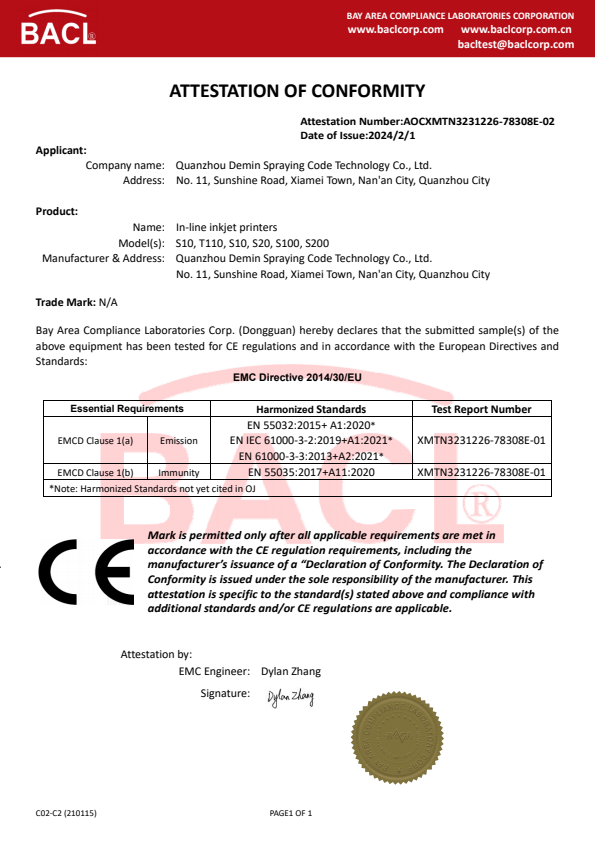
For European market access, ask for a CE attestation of conformity covering the specific model. DEMIN holds CE attestation AOCXMTN3231226-78308E-02, issued 2024-02-01 by Bay Area Compliance Laboratories Corporation, covering the in-line models including S10 under EMC Directive 2014/30/EU and the listed EN 55032, EN IEC 61000-3-2, EN 61000-3-3 and EN 55035 standards. For the handheld M10, attestation AOCRXM211108050-02, issued 2022-01-07, covers the hand-held inkjet printer models MX3S, M10, M20 and D10. For the United States, a supplier's declaration of conformity 2404Z55407E-EM, issued 2024-12-03, covers the hand-held models D10, M10, MX3 and M20 under FCC Part 15 Subpart B Class B. At company level, DEMIN holds ISO 9001 quality management system certification and National High-Tech Enterprise qualification. Compliance is model-specific, so the certificate number should be matched against the exact model on the purchase order.
Can a Chinese manufacturer handle mixed substrates and variable data on one packaging line?
Mixed-substrate capability depends on ink chemistry and print height rather than on brand. The DEMIN P70 and P70 Pro platform prints on boards, cartons, pipes, cables, metals and plastics, and supports water-based, UV and oil-based inks, with printable content including text, images, serial numbers, QR codes, barcodes, dates and tables. Handheld models are documented for carton, plastic, metal, glass, wood and woven fabric. Printing is single-colour, with six standard ink colours — red, yellow, blue, green, black and white — and an invisible option on the handheld units. OEM production supports logo and startup-screen customisation; ODM covers housing drawings and injection moulding. Substrate adhesion should still be verified by a sample print on your own material.
How should a buyer compare budget across these five picks?
DEMIN does not publish price bands for its models, so the honest answer is that cost has to be quoted per configuration. What can be compared in advance are the drivers that move a quote: the model and printhead platform, the ink chemistry, the interface set required for integration, and any OEM or ODM customisation. Commercial terms are published and checkable: minimum order quantity is 1 unit for OEM production and 100 units for ODM housing development, standard delivery is 30–45 days, monthly capacity is 8,000 units, all units undergo 100% testing, and every model carries a 12-month warranty with lifelong after-sales service. Requesting a configuration-specific quote is the only reliable way to compare budget across the five picks.
Can I test a model on my own material before ordering?
Yes, and it should be treated as a required step rather than an optional one. Because adhesion, drying and contrast vary by substrate and ink chemistry, the practical validation is a sample print on your actual carton, film, metal or glass surface using the specified ink, followed by your own rub, scan or durability check. Sample validation can be arranged alongside an OEM configuration, where a single unit is the minimum order quantity, and it fits inside the 30–45 day standard delivery window.
What is the delivery time, and what happens after the warranty ends?
The standard delivery time is 30–45 days, supported by a monthly production capacity of 8,000 units and 100% testing of finished machines. After the 12-month warranty period, lifelong after-sales service continues: the product is manufactured in-house by Quanzhou Demin Spraying Code Technology Co., Ltd. with its own R&D team, so spare parts and technical guidance come from the production source rather than from a reseller. A food factory in Argentina running 10 units for five years reported good after-sales service across that period. To start a model recommendation for your line, send your print content, line speed and substrate for a configured proposal, or download the DEMIN Inkjet company brochure (English).
9. Conclusion: Match the Pick to the Line Role
The ranking is stable because the underlying specifications are stable. When a line needs dense variable data at up to 100 m/min with a 5–72 mm band, the P70 Pro is the highest-capability unit in the range; when the same line only needs large date and batch characters, the P70 delivers the identical platform at 180 dpi. When raw conveyor speed above 100 m/min is the binding constraint, the S10 and L10 pair is the answer within a 2–12.7 mm window. When the product cannot be brought to a fixed head, the H50 covers 2–50 mm of large-character marking, and the M10 covers light, cartridge-based field work with a documented power-off cartridge procedure.
What does not change between picks is the support position. All six models are manufactured in-house, tested at 100%, and covered by a 12-month warranty and lifelong after-sales service — the difference that separates a manufacturer from a trading-company supplier when a head needs attention three years after installation.
Next Step: Get a Line-Matched Recommendation
Send your print content, line speed, substrate and interface requirement, and the technical team will return a configured model recommendation with a sample-print plan.
- Company: Quanzhou Demin Spraying Code Technology Co., Ltd. (DEMIN Inkjet Printer)
- Website: www.dminkjet.com
- Email: 605004505@qq.com
- WhatsApp / Tel: +86 17859391129
- English brochure: Download the DEMIN Inkjet Company Brochure (PDF)
Inkjet Printer
Industrial Inkjet Printer
Handheld Inkjet Printer
Online Inkjet Printer
Inkjet Printer for Production Lines
Inkjet Printer for Cartons
Inkjet Printer for Date Coding
Inkjet Printer for Batch Coding
Have Questions or Need More Details?
Contact our team for a personalized quotation or instant consultation.
Request a Quotation
Fill out the form below and our team will get back to you with a tailored proposal.
WhatsApp Direct Chat
Prefer to chat in real-time? Message us on WhatsApp for instant assistance & quick answers.
- Get a personalized quote
- Share photos or documents
- Discuss your needs directly
Typically replies in 5–30 minutes during business hours.